
High strength stainless steel used in aircraft applications

We usually call tensile strength higher than 800MPa, yield strength higher than 500MPa stainless steel is high strength stainless steel, yield strength higher than 1380MPa stainless steel is called ultra high strength stainless steel. The development of the aviation industry has proved that the improvement of aircraft and aero-engine performance largely depends on metal materials. Due to the high strength, high toughness, high stress corrosion cracking resistance and good impact resistance of steel, some key structural components of aircraft such as landing gear, girder, high stress joints, fasteners and other high strength stainless steel are still used.

High strength stainless steel mainly includes Martensite precipitation hardening stainless steel and semi – Austenite precipitation hardening stainless steel. The strength of martensite precipitation hardening stainless steel is achieved by martensite transformation and precipitation hardening treatment, the advantage is high strength, at the same time due to low carbon, high chromium, high molybdenum and/or high copper, its corrosion resistance is generally not less than 18Cr-8Ni austenitic stainless steel; Free cutting, good welding ability, do not need local annealing after welding, heat treatment process is relatively simple. The main disadvantage is that even in annealed state, its structure is still low carbon martensite, so it is difficult to conduct deep deformation cold working. The typical steel grade is 17-4PH and PH13-8Mo, used for the manufacture of high strength corrosion resistant bearing components, such as engine bearing parts, fasteners, etc. working at 400℃. PH13-8Mo is widely used in aeronautical bearing corrosion resistant medium temperature structural parts.

The semi-Austenite precipitation hardened stainless steel can be machined, coldly deformed and welded in Austenite state, and then the martensite transformation and precipitation hardening can be controlled by adjusting aging to obtain different strengths and toughness coordination. The steel has good corrosion resistance and thermal strength, especially stress corrosion resistance, and is especially suitable for the manufacture of parts used below 540℃. The disadvantage is that the heat treatment process is complex, the heat treatment temperature control requirements are very accurate (±5℃); The work hardening tendency of steel is large, and many intermediate annealing times are often needed for deep deformation cold working. Typical grades are 17-7PH, PH15-7Mo, etc. This kind of steel is mainly used in the aviation industry to work at 400℃ below the corrosion bearing structure, such as all kinds of pipes, pipe joints, springs, fasteners, etc.


Aircraft landing gear

The materials used for the construction of aircraft landing gear are 30CrMnSiNi2A, 4340, 300M, Aermet100 and other aircraft landing gear and fasteners with higher requirements are mostly made of precipitation hardened stainless steel, such as 17-4PH for THE landing gear of F-15 aircraft, 15-5pH for the landing gear of B-767 aircraft. PH13-8mo steel has the potential to replace 17-4PH, 15-5PH, 17-7PH, PH15-7Mo and other steels due to its better stress corrosion resistance than precipitation hardened stainless steel of the same grade.

The plane bearing

German FAG company developed the nitrogen-added martensite stainless steel Cronidur30 (0.31%C-0.38%N-15% Cr-L %Mo), which is produced by PESR process of electroslag remelting under high pressure nitrogen atmosphere. It is a high temperature stainless steel with high nitrogen completely hardened, which is more resistant to corrosion than SUS440. It is not suitable for high DN value (D: bearing inner diameter/mm, N: shaft revolution/arin) because of its characteristics of full hardening type, the same Cronidur30 can satisfy the residual compressive stress and fracture toughness value of DN4 million at the same time through high-frequency quenching. But the tempering temperature is lower than 15O℃, it can not withstand the rise in bearing temperature caused by thermal shock after engine shutdown.

Aircraft bearing structural components

High-strength stainless steel in aircraft bearing structure is mainly 15-5PH, 17-4PH, PH13-8Mo, etc., including hatch cover latch, high-strength bolt, spring and other parts. Civil aircraft use such high-strength stainless steel for wing spars, such as 15-5PH steel for Boeing 737-600 wing spars; Type A340-300 wing SPAR PH13-8Mo steel. Ph13-8Mo is used for parts requiring high strength and toughness, especially for transverse performance, such as fuselage frames. More recently, Custom465 has been tested due to increased toughness and stress corrosion resistance. Custom465 was developed by Carpenter on the basis of Custom450 and Custom455 for the manufacture of aircraft flap guides, slat guides, transmissions, engine mounts, etc. The steel is currently included in the MMPDS-02, AMS5936 and ASTM A564 technical specifications. HSL180 high strength stainless steel (0.21C-12.5Cr-1.0Ni-15.5Co-2.0Mo) is used to manufacture the aircraft structure, which has the same strength of 1800MPa as low alloy steel such as 4340 and the same corrosion resistance and toughness as precipitation hardened stainless steel such as SUS630.
 

なぜデュプレックスステンレス鋼が原子力発電所の冷却水システムに使用されているのですか?

クリーンエネルギー源として、原子力発電は世界的な炭素排出削減に大きく貢献しています。冷却水配管システムは原子力発電所の安全運作の鍵となります。このシステムは直径やサイズが異なる数千フィートにも及ぶパイプで構成されています。このシステムはプラント設備を冷却するために信頼性の高い水供給を提供します。非安全な配管システムはプラントの冷却に必要な十分な水供給を確保しなければならず、一方で安全システムは緊急事態が発生した場合に原子炉を制御し安全に停止させるための十分な冷却水供給を確保しなければなりません。

これらのパイプ材料は、機器の耐用期間を通じて冷却水による腐食に対して耐性を持つ必要があります。プラントの設置場所によっては、冷却水の種類は比較的清潔な淡水から汚染された海水までさまざまです。経験からいえるところでは、システムが経年劣化するにつれて、様々な腐食問題が生じ、その程度もさまざまとなり、システムを損傷させ、必要な冷却水を提供できなくなります。

冷却水配管の問題には、材料とその冷却水との相互作用が関係しています。汚染(詰まり)やシステムの腐食による漏れが最も一般的な問題です。これには堆積物の蓄積、海洋生物の付着(バイオフローリング)、腐食物質の蓄積、異物の詰まりなどが含まれます。漏れは通常、微生物による腐食(MIC)によって引き起こされます。これは、水中の特定の微生物によって引き起こされる非常に腐食性の腐食です。このタイプの腐食は、炭素鋼および低合金ステンレス鋼によく見られます。

ステンレス鋼は、新しい給水配管システムの建設や、既存の炭素鋼製システムを修理または交換する際に、長年にわたり実用的な選択肢とされてきました。配管のアップグレードソリューションに使用されるステンレス鋼は、一般的に304L、316L、または6%-Moステンレス鋼です。316Lと6% -Moステンレス鋼の性能と価格には大きな違いがあります。冷却媒体が未処理水である場合(非常に腐食性が高く、微生物による腐食のリスクがある)、304Lおよび316Lは適切な選択肢ではありません。その結果、原子力発電所では6%-Moステンレス鋼へのアップグレードが必要になったり、炭素鋼系システムの高いメンテナンスコストを余儀なくされたりしています。一部の原子力発電所では、初期コストが低いため、炭素鋼製配管をそのまま使用している場合もあります。ASTM A240によると、産業用給水配管システムは通常、以下のステンレス鋼製のものとなっています:

成績 UNS C N Cr ニ モ Cu
304L S30403 0.03 / 18.0-20.0 8.0-12.0 / /
316L S31603 0.03 / 16.0-18.0 10.0-14.0 2.0-3.0 /
6%Mo N08367 0.03 0.18-0.25 20.0-22.0 23.0-25.0 6.0-7.0 0.75
2205 S32205 0.03 0.14-0.2 22.0-23.0 4.5-6.5 3.0-3.5 /

2205デュプレックスステンレス鋼は優れた選択肢であることが証明されました。サウスカロライナ州のデューク・パワー社のキャタボア原子力発電所は、システム内で2205(UNS S32205)デュアルフェーズステンレス鋼を使用する初の原子力発電所です。このグレードには約3.2% モリブデンが含まれ、304Lおよび316Lステンレス鋼よりも耐食性および微生物による腐食に対する耐性が大幅に向上しています。

主コンデンサーの冷却塔への給水用の地上部分の配管システムにおける炭素鋼管は、2205デュプレックスステンレス鋼管に交換されました。

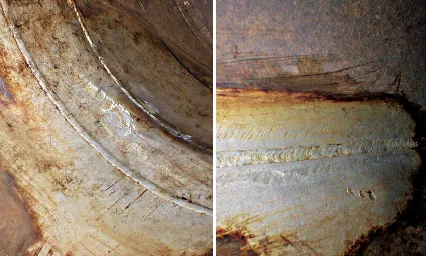
新しい代替品 2205 デュプレックスステンレス鋼管は2002年に設置されました。管の長さは60メートル、直径は76.2cmと91.4cm、壁厚は0.95cmです。管の仕様はASME B31.1 Power Pipingに従っており、これは発電所配管システムの安全な使用に関する管理規定の一つで、世界中で広く使用されています。500日間の使用を経て、管は徹底的に検査されました。検査中にはスケールや腐食は見られませんでした。2205デュプレックスステンレス鋼は非常に良好な性能を発揮しました。2205ステンレス鋼管は、設置以来10年以上も良好な性能を発揮しています。この経験に基づき、Duke Powerは2205ステンレス鋼管を使用しています。 2205デュプレックスステンレス鋼パイプ そのシステムの他の部分でも同様です。

2205パイプ内部、500日使用後の様子。


原子力発電所の水系設計者は、耐腐食性冷却水用の配管材料を選択する際に、もう一つの選択肢を持つようになりました。2205デュプレックスステンレス鋼の成功した適用により、メンテナンスコストを削減し、ダウンタイムを短縮し、原子力発電所の運転安全性を確保できます。

What’s DSS?

DSS, the abbreviation of Duplex stainless steel, is a classification of stainless steels composed of two steel with the center one composed of either austenitize or ferric. These are also known as duplex steels since their chemical structure features two distinct phases, both of which are usually represented by martensite respectively. These steels are very useful in applications requiring extreme toughness since the two phases can be applied together at high temperatures and pressures. The duplex stainless steel is able to obtain sufficient hardness in both its austenitic and martensite phases due to the presence of significant amounts of residual austenite. The commonly used DSS grades are S31803, S32750 and SS32550.

The duplex stainless steel grades

Type UNS Sweden German France Japan
Low alloy UN23(SAF2304) SS232(SAF2304) W.Nr.1.4362 UR35N DP11
Medium alloy UNS S31500

UNS S31803

SS2376(3RE60)

SS2377(SAF2205)

W.Nr.1.4417

W.Nr.1.4462

UR45N DP1

DP8

High alloy UNS S32900

UNS S31260

SS2324(10RE51) W.Nr.1.4460

W.Nr.1.4501

  329J1

329J2L

Super duplex UNS S32750

UNS S32550

SS2328(SAF2507) W.Nr.1.4410

W.Nr.1.4507

UR47N+

UR52N+


Apart from the alloy itself, another important factor that contributes to its corrosion resistance is the nickel content. Nickel is commonly found in higher percentages in most alloys, which makes it an extremely useful component. In comparison to nickel, which is often used in high-performance alloys for its electrical conductivity and ability to form good-quality alloys, nickel is not as frequently used in making high-quality duplex stainless steel. One of the most interesting aspects of nickel alloys is its corrosion resistance ability, which makes it the best alternative for high-performance materials. When mixed with the steel, nickel produces a more stable alloy, which can increase the alloy’s wear-ability and mechanical strength.

Another significant property of this alloy is its high resistance to thermal expansion. It exhibits a high level of thermal expansion resistance despite the expansion resistance ability of austenitic stainless steels, due to its superior mechanical properties. This property gives it an excellent corrosion protection capability, especially during the tempering/stain removal cycle. The excellent corrosion resistance feature of duplex stainless steel enables it to stand up against a wide range of chemicals. It also has high levels of resistance towards oil, grease and other liquids with a high viscosity level.

Apart from the above features, duplex stainless steel is also popular because of its high strength and durability. Its high strength rating of up to 300Kg is made possible through its ability to make use of two-directional mandrel rolls. It is comprised of a hard carbon fiber rolled into strips that are interlaced on both sides and formed into a bar with a mandrel. A further feature that makes it an excellent alloy is that its surface is completely smooth with no ridges.

One of the most important factors that contribute to the durability of duplex stainless steels is their low rate of pitting corrosion resistance. These steels exhibit a low rate of formation of crystalline grains inside the hot alloy. They can be used to build both large and small structures in different industries. Due to their resistance to crystalline grains, they are highly valued by the construction industry.

The mechanical properties of duplex stainless steel offer a number of benefits that make them an excellent choice for a wide range of applications. These properties allow these steels to be used for a variety of applications including precision engineering component building, heat exchangers and sheet metal fabrication. Some other important properties of this type of alloy include high heat tolerance, low density and excellent corrosion resistance. They also offer a number of mechanical properties that contribute to the overall properties of the alloy. These include extreme hardness, toughness, chemical resistance and creep resistance.

Nickel Austenitic stainless steel grades

Nickel is known to be an expensive alloying element and is essential in some applications where both stress corrosion resistance and austenite structure are required. For example, creep resistance is important in high temperature environments, where austenitic stainless steels are needed. Similar to the traditional austenitic stainless steels, the twin boundary is a significant feature of the nickel-rich austenitic stainless steels because of the lower stacking fault energy. Austenitic stainless steels are prone to stress corrosion cracking (SCC). However, the stress corrosion resistance is greatly improved when the nickel content exceeds 20%. The effect of nickel on the stress intensity of stress corrosion threshold (105℃, 22% NaCl aqueous solution) in Fe-Ni-Cr alloys containing 16%~21% chromium is studied. Nickel-rich austenitic stainless steel (NiASS) can be considered as a separate class of stainless steel. In fact, the stress corrosion resistance of biphasic and ferrite stainless steels is comparable to that of biphasic and ferrite stainless steels when the nickel content exceeds 30%. Several limited grades of nickel-rich austenitic stainless steels are listed in the table below. Super austenitic stainless steels 254SMO and 654SMO are designed specifically for the oil and gas industry. Typical applications are seawater cooling, pulp bleaching, and hydraulic and instrument piping equipment.


Ni-Austenitic stainless steels grades

Alloy C シィ Mn Cr ニ モ W Co Cu Nb N
254SMo 0.01 0.8 1.0 20 18 6.1 0.7 0.2
654SMo 0.01 3.5 24 22 7.3 0.5 0.5
Sanicro 25 0.1 0.2 0.5 22.5 25 3.6 3.5 3.0 0.5 0.23
Sanicro 28 0.02 0.6 2.0 27 31 3.5 1.0
Alloy 800 0.07 0.6 0.6 20.5 30.5
353MA 0.05 1.6 1.5 25 35 0.16
Alloy 825 0.03 0.5 0.8 20 38.5 2.6
Alloy 625 0.03 0.5 0.5 21 Bal 8.5
Alloy 690 0.02 0.5 0.5 30 60
Alloy 600 0.05 0.4 0.8 16.5 Bal 0.5

SANICRO 25, a 22Cr-25Ni alloy, is designed for use in boilers up to 700 °C. It is a material suitable for superheaters and reheaters due to its good creep fracture strength and high temperature corrosion resistance,. In fact, the creep fracture strength of SANICRO 25 is superior to that of most austenitic stainless steels in the range of 600~750℃. In a highly corrosive acidic environment, The Sanicro 28 is usually the best choice. It is used in high-intensity drilling Wells with tubing, casing and acid gas lining, and other applications include heaters, pump systems, and pumps and containers in wet phosphoric acid plants and super phosphoric acid plants.

Alloy 800 is often used in the environment range from 550 to 1100℃, which requires excellent creep resistance, good high-temperature corrosion resistance and high-temperature strength of materials. These alloys are also used in the inlet and outlet ports of the production of ammonia, methanol and civil gas, as well as in the furnace tubes used in the production of vinyl chloride and ethylene. Other applications include heat exchange tubes and radiation tubes for fluidized combustion beds and parts of heat treatment furnaces, such as muffler tubes and protective sleeves for thermocouples.

The 25Cr-35Ni alloy 353Ma is designed for use in cracking furnaces and reforming tubes where synthetic gases are treated in environments where carburizing and nitrogen absorption are potentially problematic. Although there are other alternatives that contain more chromium, 353 MA is the best choice. One reason is that it contains the element Ce, which helps form a very stable surface oxide layer.

Alloy 690 contains 60 percent nickel and is used mainly in the piping of steam generators in nuclear power plants. The operating temperature is 365℃, at which the stress corrosion crack between grains is a potential problem. Under given service conditions, alloy 690 is almost free from corrosion, making it the preferred alloy.

It is interesting to note that nickel-rich Austenitic stainless steel 254SMO is also used for art. “God, Over the Rainbow” sculpture by Carl Milles was installed in 1995 on the south coast of the Nak Strand in Stockholm. The sculpture is about 23m high and is a famous scenic spot where a large number of sailors pass by every day. The surrounding seawater contains salt, chloride is very easy to cause surface corrosion, high strength super austenitic stainless steel 254SMO is very suitable for this environment.

When Stainless steel bellows used in shell heat exchanger

The bellows tube heat exchanger is an upgrade based on a straight (bright) tube heat exchanger. The design of the crest and trough of the wave inherits the advantages of the tubular heat exchanger such as durability and safety, and at the same time overcomes the defects such as poor heat transfer capacity and easy scaling. The principle is to improve the total heat transfer coefficient so as to reduce the required heat transfer area, which can save materials and reduce weight under the same heat transfer effect.

Because the bellows body is processed by cold pressing of bright pipe billet, it is generally believed that the bellows body can be strengthened after forming. The external pressure stability experiment shows that the instability of the corrugated heat exchange tube under external pressure first occurs in the straight pipe section, and the corrugated tube will be unstable only if the external pressure continues to rise. This indicates that the stability of the corrugated section is better than that of the straight section and that the critical pressure of the corrugated section is higher than that of the straight section.

Experiments show that the ripple of buckling deformation occurred in the wave trough, especially local single wave trough, generally not more than two troughs instability at the same time, it shows that the stability of the wave crest is better than trough but sometimes also can appear the opposite, in the cold pressing mark process, both trough and the wall thickness of the straight section is constant, cold after the tube is actually shorter.

The existence of wave peaks and troughs in the bellows increases the effect of radial heat exchange convection in the tubes, as shown in Fig below:

Radial convection has a great influence on the total heat transfer coefficient, which is the fundamental reason for the low price and lightweight of the double tube plate bellows heat exchanger. The heat exchange area of the tube body surface of the bellows and the straight tube is large at the same length, but this change is far less than the contribution of changing the coefficient value. It can be clearly seen that the flow velocity of the straight (light) tube is significantly reduced when it is close to the tube wall.

The shell heat exchanger with bellows can make the fluid speed and direction of constant change to form turbulence compared with a straight tube exchanger, making exchange heat with the wall, the boundary effect that affects heat transfer will no longer exist. The total heat transfer coefficient can be increased by 2 ~ 3 times, and the actual operation can even reach 5 times, and the weight is light, which is the reason why the price of bellows heat exchanger is lower than that of the straight tube heat exchanger. According to calculation and practical experience, the total heat transfer coefficient of 1 mm thick bellows is 10% lower than that of 0.5 mm thick bellows. The operation data of hundreds of bellows heat exchangers show that the wall thickness (almost all 0.5 mm) is the main reason for the operation of 10 ~ 14 years without major repair or damage.

In addition, the bellows heat exchanger can effectively resist the impact of a water hammer. The shell of the double tube plate heat exchanger is connected with an expansion joint. If it suffers from the impact of water hammer, the expansion joint will be misplaced. This happens to both bellows and straight tube heat exchangers, and the deformation of the shell may cause the tube to twist. It is because the bellows have more expansion margin, the elastic margin of strain is large when undergoing deformation, that is to say, the ability to resist instability is strong in this case. But in any case, in the process of installation to avoid the occurrence of water hammer, can be taken through the use of Angle sitting valve, delay switch and other measures.

Advantages of stainless steel bellow shell heat exchanger

  • High heat transfer efficiency

The special crest and trough design of the bellows makes the fluid flow because of the continuous mutation of the inside and outside section of the tube to form a strong turbulence. Even in the case of a very small flow rate, the fluid can form a strong disturbance inside and outside the tube, which greatly improves the heat transfer coefficient of the heat exchange tube. The heat transfer coefficient is 2~3 times higher than that of the traditional tube heat exchanger.

  • No scaling and blocking

The medium inside and outside the bellows is always in a highly turbulent state, which makes the solid particles in the medium-difficult to deposit scale; On the other hand, affected by the temperature difference of the medium will produce a trace of axial expansion deformation, the curvature will change frequently, the dirt and heat exchange tube will produce a large pull force, even if there is scale calm will therefore break off automatically, so that the heat exchanger has always maintained a lasting, better heat transfer performance.

  • Automatic compensation

The special structure and shape of bellows can effectively reduce the thermal stress under the condition of being heated without adding expansion joints, thus simplifying the structure of products and improving the reliability of products.

  • Long service life

The axial expansion ability is enhanced, which effectively reduces the temperature difference stress and can adapt to the large temperature difference and pressure change, so there will be no leakage caused by pipe mouth rupture. The connection between the baffle plate and the bellows extends the service life of the heat exchanger.


How the Nitrogen affect 316LN stainless steel?

316LN is the Nitrogen addition version based on 316L steel (0.06% ~ 0.08%), so that it has the same characteristics as 316L,  has been used in the manufacture of high-temperature structural components in fast breeder reactor (FBRS). Reducing the carbon content greatly reduces the susceptibility to stress corrosion cracking due to welding in subsequent corrosive environments. The creep, low cycle fatigue and creep-fatigue interaction are the most important considerations for FBRS components. The high-temperature strength of 316L stainless steel can be improved to 316 stainless steel by alloying 0.06% ~ 0.08% N. The influence of nitrogen content higher than 0.08% on mechanical properties of 316L stainless steel at high temperature will be discussed in this paper.


Chemical composition of 316LN stainless steel

Furnace N C Mn Cr モ ニ シィ S P Fe
Standards 0.06-0.22 0.02-0.03 1.6-2.0 17-18 2.3-2.5 12.0-12.5 ≤0.5 ≤0.01 ≤0.03 –
1 0.07 0.027 1,7 17.53 2.49 12.2 0.22 0.0055 0.013 –
2 0.11 0.033 1.78 17.63 2.51 12.27 0.21 0.0055 0.015 –
3 0.14 0.025 1.74 17.57 2.53 12.15 0.20 0.0041 0.017 –
4 0.22 0.028 1.70 17.57 2.54 12.36 0.20 0.0055 0.018 –

Thses four batches of 316LN stainless steel with a nitrogen content of 0.07%, 0.11%, 0.14% and 0.22%, and carbon content of 0.03%, were tested to study the effects of nitrogen on tensile, creep, low-cycle fatigue and creep-fatigue properties of 316LN stainless steel. The aim of this experiment is to find the optimum nitrogen content to obtain the best combination of tensile, creep and low cycle fatigue properties. The experimental results show that nitrogen can improve the tensile strength, creep and fatigue strength of austenitic stainless steels. The reasons for the increase in strength include solution enhancement, reduced stacking fault energy (SFE), precipitation hardening, formation of composites (interstitial solutes), atomic segregation, and ordered hardening. Due to their different electron exchange properties, the dissolved nitrogen in austenitic stainless steel has a larger expansion volume than carbon.

In addition to the elastic interaction between nitrogen and dislocation, the electrostatic interstitial dislocation interaction also influences the strength. Dislocation nuclei are characterized by the lack of free electrons, which means they have a positive charge. The nitrogen atoms in austenitic stainless steels are negatively charged due to the position of free electrons near the nitrogen atoms and the electrostatic interaction between the dislocations and the nitrogen atoms.

The effective binding energy between the nitrogen atom and the dislocation increases with the increase of the nitrogen content in Austenitic steel, but the correlation is not obvious for carbon. In Austenitic steels, interstitial nitrogen interacts with substituent elements and tends to form interstitial substituent atomic compositions. The compound binds easily to elements to the left of Fe in the periodic table, such as Mn, Cr, Ti and V. There is a strong correlation between the properties of interatomic bonding (that is, orientation versus unorientation) and the proximity of adjacent atoms in a multicomponent alloy system. Bonding between metal atoms facilitates short-range ordering, which is the bonding of atoms of different elements. Interatomic polarization facilitates the exchange of covalent electrons, the bonding between atoms of the same element. Carbon promotes the aggregation of substitution atoms in the iron-based solid solution, while nitrogen facilitates short-range ordering.

In general, the yield strength(YS) and ultimate tensile strength(UTS) of 316L stainless steel are significantly improved by the alloying of 0.07% ~ 0.22% nitrogen. The increase in strength was observed in all tests in the temperature range of 300 ~ 1123K. Dynamic strain aging was observed within a limited temperature range. The temperature range of dynamic strain aging (DSA) decreases with the increase of nitrogen content.