
Hoge sterkte roestvrij staal gebruikt in vliegtuigtoepassingen

We noemen meestal een treksterkte hoger dan 800 MPa; roestvrij staal met een treksterkte hoger dan 500 MPa wordt een roestvrij staal met hoge sterkte; roestvrij staal met een treksterkte hoger dan 1380 MPa wordt een ultra-hoogsterkte roestvrij staal genoemd. De ontwikkeling van de luchtvaartindustrie heeft aangetoond dat de verbetering van de prestaties van vliegtuigen en vliegtuigmotoren grotendeels afhankelijk is van metalen materialen. Dankzij de hoge sterkte, de hoge taaiheid, de hoge krasbestendigheid tegen corrosie bij hoge spanning en de goede slagvastheid van staal worden sommige belangrijke structurele componenten van vliegtuigen, zoals landingsgestel, brugdeel, hoogspanningsverbindingen, bevestigingsmiddelen en andere roestvrij staalsoorten met hoge sterkte nog steeds gebruikt.

Roestvrij staal met hoge sterkte omvat voornamelijk Martensiet-precipitatiehardstaal en semi-Austenit-precipitatiehardstaal. De sterkte van het Martensiet-precipitatiehardstaal wordt verkregen door de transformatie van het Martensiet en de precipitatiehardheidsbehandeling; het voordeel is een hoge sterkte; tegelijkertijd vanwege het lage gehalte aan koolstof, hoog chroom, hoog molybdeen en/of hoog koper is de corrosieweerstand over het algemeen niet minder dan 18Cr-8Ni austenitisch roestvrij staal; vrij snijden, goede lasbaarheid, geen lokale warmtebehandeling na het lassen nodig; het warmtebehandelingsproces is relatief eenvoudig. Het belangrijkste nadeel is dat het structuur van het staal ook na het verharden nog steeds een laag gehalte aan koolstof bevat, waardoor het moeilijk is om diepe vormveranderingen bij koud bewerken uit te voeren. De meest voorkomende staallegering is 17-4PH en PH13-8Mo, gebruikt voor de productie van corrosiebestendige lagermaterialen met hoge sterkte, zoals motorlagers, bevestigingsmiddelen, enz. Werkend bij 400°C. PH13-8Mo wordt veel gebruikt in structurele onderdelen voor corrosiebestendige lagers in de luchtvaartindustrie.

Het semi-austenitische, geharde roestvrij staal kan in de austenitische toestand worden bewerkt, koud vervormd en gelast, en vervolgens kan de martenziet-omvorming en de geharde precipitation worden gecontroleerd door het aanpassen van de verouderingstijd om een goede coördinatie van sterkte en taaiheid te verkrijgen. Het staal heeft een goede corrosieweerstand en thermische sterkte, met name tegen stresscorrosie, en is vooral geschikt voor de vervaardiging van onderdelen die worden gebruikt bij temperaturen onder 540 °C. Het nadeel is dat het warmtebehandelingsproces complex is, de vereisten voor de temperatuurregeling bij het warmtebehandelen zijn zeer nauwkeurig (±5 °C); de warmteverhardingsneiging van het staal is groot en er zijn vaak meerdere tussenliggende warmtebehandelingsfasen nodig voor diepvervormende koudebewerking. Typische kwaliteiten zijn: 17-7PHPH15-7Mo, enzovoort. Dit soort staal wordt voornamelijk gebruikt in de luchtvaartindustrie om onder een corrosiebestendige omgeving van 400°C te werken, zoals allerlei buizen, pijpverbindingen, veren, bevestigingsmiddelen enzovoort.


Vliegplatform van een vliegtuig

De materialen die worden gebruikt voor de constructie van de landingsgestellen van vliegtuigen zijn 30CrMnSiNi2A, 4340, 300M, Aermet100 en andere materialen die geschikt zijn voor vliegtuigen. De landingsgestellen en bevestigingsmiddelen met hogere eisen worden meestal gemaakt van roestvrij staal met een precipitationhardeningsproces, zoals 17-4PH Voor de landingsgestellen van F-15-vliegtuigen is 15-5pH geschikt, voor de landingsgestellen van B-767-vliegtuigen is 15-5pH geschikt. Staal met een PH-waarde van 13-8mo heeft het potentieel om 17-4PH te vervangen. 15-5PH, 17-7PH, PH15-7Mo en andere staalsoorten vanwege de betere stresscorrosiebestendigheid dan precipitation-hardversteld roestvrij staal van dezelfde kwaliteit.

Het vliegtuig dat zich voortbeweegt

Het Duitse bedrijf FAG ontwikkelde het stikstofgevoede martensietroestvrij staal Cronidur30 (0,C-0,N-15% Cr-L %Mo), dat wordt geproduceerd volgens het PESR-proces van elektroslagremelning onder een hoge druk in een stikstofatmosfeer. Het is een roestvrij staal met een hoge nitraatgehalte dat volledig gehard is. Dit roestvrij staal is bestand tegen corrosie en is dus meer bestand tegen corrosie dan SUS440. Het is niet geschikt voor hoge DN-waarden (D: binnendiameter van het lager/mm, N: omwenteling van de as/min) vanwege het volledige harden van het staal. Hetzelfde Cronidur30 kan de resterende drukspanning en de breukstevigheid bij DN4 miljoen tegelijkertijd behouden door middel van hoge-frequentie-verhitting. De temperatuur van het temperen is echter lager dan 15O°C. Het kan de temperatuurstijging van het lager niet weerstaan die wordt veroorzaakt door thermische schokken na het afsluiten van de motor.

Vliegtuigen met structurele onderdelen

Hoge sterkte roestvrij staal in vliegtuiglagerstructuren is voornamelijk 15-5PH, 17-4PH, PH13-8Mo, enz., inclusief sluiting voor de luikkap, een sterktebout, een veer en andere onderdelen. Burgerluchtvaartuigen gebruiken dergelijke hoogwaardig roestvrij staal voor vleugelspanten, zoals staal van 15-5PH voor de vleugelspanten van de Boeing 737-600; staal van type A340-300 voor vleugelspanten PH13-8Mo. Ph13-8Mo wordt gebruikt voor onderdelen die een hoge sterkte en taaiheid vereisen, vooral voor transversale prestaties, zoals rompframes. In het recente verleden is Custom465 getest vanwege de verbeterde taaiheid en de weerstand tegen spanningscorrosie. Custom465 is ontwikkeld door Carpenter op basis van Custom450 en Custom455 voor de vervaardiging van vleugelgeleiders, slatgeleiders, transmissies, motorophangingen, enz. Het staal is momenteel opgenomen in de technische specificaties MMPDS-02, AMS5936 en ASTM A564. HSL180 roestvrij staal met hoge sterkte (0.21C-12.5Cr-1.0Ni-15.5Co-2.0Mo) wordt gebruikt voor de vervaardiging van de vliegtuigstructuur, die dezelfde sterkte heeft van 1800 MPa als laaglegeringsstaal zoals 4340 en dezelfde corrosieweerstand en taaiheid als precipitatiegehard roestvrij staal zoals SUS630.
 

Why is duplex stainless steel used in nuclear power plant cooling water systems?

As a clean energy source, nuclear power is a major contributor to reducing carbon emissions worldwide. The cooling water piping system is the key to the safe operation of a nuclear power plant. It consists of thousands of feet of pipes of various diameters and sizes. It provides a reliable water supply for the cooling of plant equipment. The non-safety piping system must provide enough cooling water to cool the plant, while the safety system must provide enough cooling water to bring the reactor under control and safely shut it down in case of an emergency.

These pipe materials must be resistant to cooling water corrosion throughout the service life of the equipment. Depending on the plant’s location, the type of cooling water can range from relatively clean fresh water to contaminated seawater. Experience has shown that as systems age, a variety of corrosion problems and varying degrees of corrosion can occur, damaging the system and preventing it from providing the required cooling water.

Problems with cooling water piping often involve materials and their interactions with cooling water. Leakage from fouling (plugging) and corrosion of the system are the most common problems, including sediment accumulation, Marine biological attachment (biofouling), accumulation of corrosion products, and blockage of foreign matter. Leakage is usually caused by microbial corrosion (MIC), which is very corrosive corrosion caused by certain microorganisms in water. This form of corrosion occurs frequently in carbon steel and low-alloyed stainless steel.

Stainless steel has long been considered a viable option for building new water supply piping systems and for repairing or replacing existing carbon steel systems. The stainless steel commonly used in piping upgrade solutions is 304L, 316L, or 6%-Mo stainless steel. 316L and 6% Mo stainless steel yo big differences in performance and price. If the cooling medium is untreated water, which is highly corrosive and carries a risk of microbial corrosion, 304L and 316L are not suitable choices. As a result, nuclear plants have had to upgrade to 6%-Mo stainless steel or accept the high maintenance costs of carbon steel systems. Some nuclear power plants still use carbon steel lining pipes because of the lower initial cost. According to ASTM A240,Industrial water supply piping systems are often made of stainless steel below:

Puntentelling UNS C N Cr Ni Mo Cu
304L S30403 0.03 / 18.0-20.0 8.0-12.0 / /
316L S31603 0.03 / 16.0-18.0 10.0-14.0 2.0-3.0 /
6%Mo N08367 0.03 0.18-0.25 20.0-22.0 23.0-25.0 6.0-7.0 0.75
2205 S32205 0.03 0.14-0.2 22.0-23.0 4.5-6.5 3.0-3.5 /

The 2205 duplex stainless steel proved to be an excellent choice. Duke Power’s Catawba nuclear power plant in South Carolina is the first nuclear power plant to use 2205 (UNS S32205) dual-phase stainless steel in its systems. This grade contains approximately 3.2% molybdenum and has improved corrosion resistance and significantly better microbial corrosion resistance than 304L and 316L stainless steels.

The carbon steel lining piping on the overground portion of the piping system conveying the supply water to the cooling tower of the main condenser was replaced with 2205 duplex stainless steel piping.

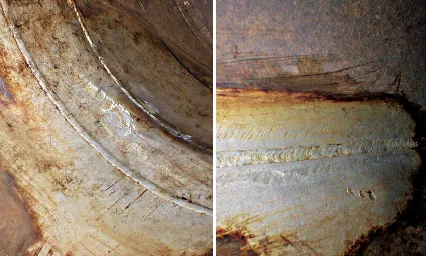
The new replacement 2205 duplex stainless steel pipe was installed in 2002. The pipe is 60 meters long, 76.2 cm and 91.4 cm in diameter, and the wall thickness of the pipe is 0.95 cm. The system specified in accordance with ASME B31.1 Power piping, which is one of the management codes for the safe use of power plant piping systems and is widely used in the world. After 500 days of service, the system was thoroughly inspected. No scaling or corrosion was found during the inspection. 2205 duplex stainless steel performed very well. 2205 stainless steel piping has been performing well for more than a decade since its installation. Based on this experience, Duke Power has used 2205 duplex stainless steel pipes in other parts of its system.

Internal of 2205 pipe after 500 days use.


Designers of nuclear power plant water systems now have one more option when it comes to choosing piping materials for corrosion-resistant cooling water. The successful application of 2205 duplex stainless steel can reduce maintenance costs, reduce downtime and ensure the operation safety of nuclear power plants.

Wat is DSS?

DSS, the abbreviation of Duplex stainless steel, is a classification of stainless steels composed of two steel with the center one composed of either austenitize or ferric. These are also known as duplex steels since their chemical structure features two distinct phases, both of which are usually represented by martensite respectively. These steels are very useful in applications requiring extreme toughness since the two phases can be applied together at high temperatures and pressures. The duplex stainless steel is able to obtain sufficient hardness in both its austenitic and martensite phases due to the presence of significant amounts of residual austenite. The commonly used DSS grades are S31803, S32750 and SS32550.

The duplex stainless steel grades

Type UNS Sweden German France Japan
Low alloy UN23(SAF2304) SS232(SAF2304) W.Nr.1.4362 UR35N DP11
Medium alloy UNS S31500

UNS S31803

SS2376(3RE60)

SS2377(SAF2205)

W.Nr.1.4417

W.Nr.1.4462

UR45N DP1

DP8

High alloy UNS S32900

UNS S31260

SS2324(10RE51) W.Nr.1.4460

W.Nr.1.4501

  329J1

329J2L

Super duplex UNS S32750

UNS S32550

SS2328(SAF2507) W.Nr.1.4410

W.Nr.1.4507

UR47N+

UR52N+


Apart from the alloy itself, another important factor that contributes to its corrosion resistance is the nickel content. Nickel is commonly found in higher percentages in most alloys, which makes it an extremely useful component. In comparison to nickel, which is often used in high-performance alloys for its electrical conductivity and ability to form good-quality alloys, nickel is not as frequently used in making high-quality duplex stainless steel. One of the most interesting aspects of nickel alloys is its corrosion resistance ability, which makes it the best alternative for high-performance materials. When mixed with the steel, nickel produces a more stable alloy, which can increase the alloy’s wear-ability and mechanical strength.

Another significant property of this alloy is its high resistance to thermal expansion. It exhibits a high level of thermal expansion resistance despite the expansion resistance ability of austenitic stainless steels, due to its superior mechanical properties. This property gives it an excellent corrosion protection capability, especially during the tempering/stain removal cycle. The excellent corrosion resistance feature of duplex stainless steel enables it to stand up against a wide range of chemicals. It also has high levels of resistance towards oil, grease and other liquids with a high viscosity level.

Apart from the above features, duplex stainless steel is also popular because of its high strength and durability. Its high strength rating of up to 300Kg is made possible through its ability to make use of two-directional mandrel rolls. It is comprised of a hard carbon fiber rolled into strips that are interlaced on both sides and formed into a bar with a mandrel. A further feature that makes it an excellent alloy is that its surface is completely smooth with no ridges.

One of the most important factors that contribute to the durability of duplex stainless steels is their low rate of pitting corrosion resistance. These steels exhibit a low rate of formation of crystalline grains inside the hot alloy. They can be used to build both large and small structures in different industries. Due to their resistance to crystalline grains, they are highly valued by the construction industry.

The mechanical properties of duplex stainless steel offer a number of benefits that make them an excellent choice for a wide range of applications. These properties allow these steels to be used for a variety of applications including precision engineering component building, heat exchangers and sheet metal fabrication. Some other important properties of this type of alloy include high heat tolerance, low density and excellent corrosion resistance. They also offer a number of mechanical properties that contribute to the overall properties of the alloy. These include extreme hardness, toughness, chemical resistance and creep resistance.

Nikkel Austenitische roestvrijstalen kwaliteiten

Het is bekend dat nikkel een duur legerend element is en essentieel is in bepaalde toepassingen waar zowel de weerstand tegen spanningscorrosie als de austenitstructuur vereist zijn. Bijvoorbeeld is de kruipweerstand belangrijk in omgevingen met hoge temperaturen, waar austenitisch nikkel Roestvrij staalsoorten Vergelijkbaar met de traditionele austenitische roestvrijstalen, is de tweevlakstructuur een belangrijk kenmerk van de nikkelrijke austenitische roestvrijstalen vanwege de lagere stijfheidsbreukenergie. Austenitische roestvrijstalen zijn vatbaar voor spanningscorrosie-cracking (SCC). De spanningscorrosiebestendigheid wordt echter sterk verbeterd wanneer het nikkelgehalte hoger is dan 20%. Het effect van nikkel op de spanningsintensiteit van de spanningscorrosiegrens (105°C, 22% NaCl-waterige oplossing) in Fe-Ni-Cr-legeringen met 16 % tot 21% chroom wordt onderzocht. Austenitische roestvrijstalen met een hoog nikkelgehalte (NiASS) kunnen worden beschouwd als een aparte klasse van roestvrijstalen. In feite is de spanningscorrosiebestendigheid van bifasische en ferritische roestvrijstalen vergelijkbaar met die van bifasische en ferritische roestvrijstalen wanneer het nikkelgehalte hoger is dan 30%. Er zijn verschillende beperkte kwaliteiten van austenitische roestvrijstalen met een hoog nikkelgehalte. Roestvrij staalsoorten De onderstaande tabel bevat een lijst met superoestetische roestvrijstalen 254SMO en 654SMO. Deze staalsoorten zijn speciaal ontworpen voor de olie- en gasindustrie. Typische toepassingen zijn koeling van zeewater, bleken van pulp en hydraulische en instrumentatieleidingen.


Ni-Austenitische roestvrijstalen kwaliteiten

Legering C Si Mn Cr Ni Mo W Co Cu Nb N
254SMo 0.01 0.8 1.0 20 18 6.1 0.7 0.2
654SMo 0.01 3.5 24 22 7.3 0.5 0.5
Sanicro 25 0.1 0.2 0.5 22.5 25 3.6 3.5 3.0 0.5 0.23
Sanicro 28 0.02 0.6 2.0 27 31 3.5 1.0
Alloy 800 0.07 0.6 0.6 20.5 30.5
353MA 0.05 1.6 1.5 25 35 0.16
Legering 825 0.03 0.5 0.8 20 38.5 2.6
Legering 625 0.03 0.5 0.5 21 Bal 8.5
Alloy 690 0.02 0.5 0.5 30 60
Alloy 600 0.05 0.4 0.8 16.5 Bal 0.5

SANICRO 25, een legering van 22Cr-25Ni, is ontworpen voor gebruik in ketels tot 700 °C. Het is een materiaal dat geschikt is voor superheaters en herverwarmers vanwege de goede kruipkracht en hoge temperatuurbescherming tegen corrosie. In feite is de kruipkracht van SANICRO 25 groter dan die van de meeste austenitische roestvrijstalen staalsoorten in het bereik van 600~750 °C. In een zeer corrosieve zure omgeving is de Sanicro 28 meestal de beste keuze. Het wordt gebruikt in boorgaten met hoge intensiteit waarbij buizen, mantelbuizen en zuurgasbekleding worden gebruikt, en andere toepassingen omvatten verwarmers, pompinstallaties en pompen en containers in natte fosforzuurfabrieken en superfosforzuurfabrieken.

Alloy 800 wordt vaak gebruikt in omgevingen waarbij de temperatuur ligt tussen 550 en 1100 °C. Dit vereist een uitstekende kruipbestendigheid, een goede corrosieweerstand bij hoge temperaturen en een hoge temperatuurbestendigheid van de materialen. Deze legeringen worden ook gebruikt in de inlaat- en uitlaatopeningen bij de productie van ammoniak, methanol en civielgas, evenals in de ovenbuizen die worden gebruikt bij de productie van vinylchloride en ethyleen. Andere toepassingen zijn warmtewisselaarslangen en stralingsbuizen voor fluidized-combustiebedden en onderdelen van warmtebehandelingsovens, zoals uitlaatpijpen en beschermende kappen voor thermokoppels.

Het 25Cr-35Ni-legeringsmateriaal 353Ma is ontworpen voor gebruik in kraakovens en reformingbuizen waar synthetische gassen worden verwerkt in omgevingen waar carburatie en zuurstofabsorptie potentieel problematisch kunnen zijn. Hoewel er andere alternatieven bestaan die meer chroom bevatten, is 353 MA de beste keuze. Een reden hiervoor is dat het element Ce bevat, wat helpt bij het vormen van een zeer stabiele oppervlakteoxide laag.

Alloy 690 bevat 60 procent nikkel en wordt voornamelijk gebruikt voor het aanleggen van leidingen voor stoomgeneratoren in kerncentrales. De werkende temperatuur is 365℃, waarbij de stresscorrosie-cracks tussen de korrels een potentieel probleem vormen. Onder bepaalde gebruiksomstandigheden is Alloy 690 vrij van corrosie, waardoor het de voorkeurstype is.

Het is interessant op te merken dat ook austenitisch roestvrij staal met nikkelgehalte 254SMO wordt gebruikt voor kunstwerken. De sculptuur “God, Over the Rainbow” van Carl Milles werd in 1995 geplaatst aan de zuidkust van het Nak Strand in Stockholm. De sculptuur is ongeveer 23 meter hoog en is een beroemde bezienswaardigheid waar dagelijks een groot aantal zeelui passeert. Het omringende zeewater bevat zout. Chloor is zeer gemakkelijk om oppervlaktecorrosie te veroorzaken. De superaustenitische roestvrij staalsoort 254SMO is zeer geschikt voor deze omgeving.

Bij het gebruik van roestvrijstalen balgen in de behuizing van een warmtewisselaar

The bellows tube heat exchanger is an upgrade based on a straight (bright) tube heat exchanger. The design of the crest and trough of the wave inherits the advantages of the tubular heat exchanger such as durability and safety, and at the same time overcomes the defects such as poor heat transfer capacity and easy scaling. The principle is to improve the total heat transfer coefficient so as to reduce the required heat transfer area, which can save materials and reduce weight under the same heat transfer effect.

Because the bellows body is processed by cold pressing of bright pipe billet, it is generally believed that the bellows body can be strengthened after forming. The external pressure stability experiment shows that the instability of the corrugated heat exchange tube under external pressure first occurs in the straight pipe section, and the corrugated tube will be unstable only if the external pressure continues to rise. This indicates that the stability of the corrugated section is better than that of the straight section and that the critical pressure of the corrugated section is higher than that of the straight section.

Experiments show that the ripple of buckling deformation occurred in the wave trough, especially local single wave trough, generally not more than two troughs instability at the same time, it shows that the stability of the wave crest is better than trough but sometimes also can appear the opposite, in the cold pressing mark process, both trough and the wall thickness of the straight section is constant, cold after the tube is actually shorter.

The existence of wave peaks and troughs in the bellows increases the effect of radial heat exchange convection in the tubes, as shown in Fig below:

Radial convection has a great influence on the total heat transfer coefficient, which is the fundamental reason for the low price and lightweight of the double tube plate bellows heat exchanger. The heat exchange area of the tube body surface of the bellows and the straight tube is large at the same length, but this change is far less than the contribution of changing the coefficient value. It can be clearly seen that the flow velocity of the straight (light) tube is significantly reduced when it is close to the tube wall.

The shell heat exchanger with bellows can make the fluid speed and direction of constant change to form turbulence compared with a straight tube exchanger, making exchange heat with the wall, the boundary effect that affects heat transfer will no longer exist. The total heat transfer coefficient can be increased by 2 ~ 3 times, and the actual operation can even reach 5 times, and the weight is light, which is the reason why the price of bellows heat exchanger is lower than that of the straight tube heat exchanger. According to calculation and practical experience, the total heat transfer coefficient of 1 mm thick bellows is 10% lower than that of 0.5 mm thick bellows. The operation data of hundreds of bellows heat exchangers show that the wall thickness (almost all 0.5 mm) is the main reason for the operation of 10 ~ 14 years without major repair or damage.

In addition, the bellows heat exchanger can effectively resist the impact of a water hammer. The shell of the double tube plate heat exchanger is connected with an expansion joint. If it suffers from the impact of water hammer, the expansion joint will be misplaced. This happens to both bellows and straight tube heat exchangers, and the deformation of the shell may cause the tube to twist. It is because the bellows have more expansion margin, the elastic margin of strain is large when undergoing deformation, that is to say, the ability to resist instability is strong in this case. But in any case, in the process of installation to avoid the occurrence of water hammer, can be taken through the use of Angle sitting valve, delay switch and other measures.

Advantages of stainless steel bellow shell heat exchanger

  • High heat transfer efficiency

The special crest and trough design of the bellows makes the fluid flow because of the continuous mutation of the inside and outside section of the tube to form a strong turbulence. Even in the case of a very small flow rate, the fluid can form a strong disturbance inside and outside the tube, which greatly improves the heat transfer coefficient of the heat exchange tube. The heat transfer coefficient is 2~3 times higher than that of the traditional tube heat exchanger.

  • No scaling and blocking

The medium inside and outside the bellows is always in a highly turbulent state, which makes the solid particles in the medium-difficult to deposit scale; On the other hand, affected by the temperature difference of the medium will produce a trace of axial expansion deformation, the curvature will change frequently, the dirt and heat exchange tube will produce a large pull force, even if there is scale calm will therefore break off automatically, so that the heat exchanger has always maintained a lasting, better heat transfer performance.

  • Automatic compensation

The special structure and shape of bellows can effectively reduce the thermal stress under the condition of being heated without adding expansion joints, thus simplifying the structure of products and improving the reliability of products.

  • Long service life

The axial expansion ability is enhanced, which effectively reduces the temperature difference stress and can adapt to the large temperature difference and pressure change, so there will be no leakage caused by pipe mouth rupture. The connection between the baffle plate and the bellows extends the service life of the heat exchanger.


How the Nitrogen affect 316LN stainless steel?

316LN is the Nitrogen addition version based on 316L steel (0.06% ~ 0.08%), so that it has the same characteristics as 316L,  has been used in the manufacture of high-temperature structural components in fast breeder reactor (FBRS). Reducing the carbon content greatly reduces the susceptibility to stress corrosion cracking due to welding in subsequent corrosive environments. The creep, low cycle fatigue and creep-fatigue interaction are the most important considerations for FBRS components. The high-temperature strength of 316L stainless steel can be improved to 316 stainless steel by alloying 0.06% ~ 0.08% N. The influence of nitrogen content higher than 0.08% on mechanical properties of 316L stainless steel at high temperature will be discussed in this paper.


Chemical composition of 316LN stainless steel

Furnace N C Mn Cr Mo Ni Si S P Fe
Normen 0.06-0.22 0.02-0.03 1.6-2.0 17-18 2.3-2.5 12.0-12.5 ≤0.5 ≤0.01 ≤0.03 –
1 0.07 0.027 1,7 17.53 2.49 12.2 0.22 0.0055 0.013 –
2 0.11 0.033 1.78 17.63 2.51 12.27 0.21 0.0055 0.015 –
3 0.14 0.025 1.74 17.57 2.53 12.15 0.20 0.0041 0.017 –
4 0.22 0.028 1.70 17.57 2.54 12.36 0.20 0.0055 0.018 –

Thses four batches of 316LN stainless steel with a nitrogen content of 0.07%, 0.11%, 0.14% and 0.22%, and carbon content of 0.03%, were tested to study the effects of nitrogen on tensile, creep, low-cycle fatigue and creep-fatigue properties of 316LN stainless steel. The aim of this experiment is to find the optimum nitrogen content to obtain the best combination of tensile, creep and low cycle fatigue properties. The experimental results show that nitrogen can improve the tensile strength, creep and fatigue strength of austenitic stainless steels. The reasons for the increase in strength include solution enhancement, reduced stacking fault energy (SFE), precipitation hardening, formation of composites (interstitial solutes), atomic segregation, and ordered hardening. Due to their different electron exchange properties, the dissolved nitrogen in austenitic stainless steel has a larger expansion volume than carbon.

In addition to the elastic interaction between nitrogen and dislocation, the electrostatic interstitial dislocation interaction also influences the strength. Dislocation nuclei are characterized by the lack of free electrons, which means they have a positive charge. The nitrogen atoms in austenitic stainless steels are negatively charged due to the position of free electrons near the nitrogen atoms and the electrostatic interaction between the dislocations and the nitrogen atoms.

The effective binding energy between the nitrogen atom and the dislocation increases with the increase of the nitrogen content in Austenitic steel, but the correlation is not obvious for carbon. In Austenitic steels, interstitial nitrogen interacts with substituent elements and tends to form interstitial substituent atomic compositions. The compound binds easily to elements to the left of Fe in the periodic table, such as Mn, Cr, Ti and V. There is a strong correlation between the properties of interatomic bonding (that is, orientation versus unorientation) and the proximity of adjacent atoms in a multicomponent alloy system. Bonding between metal atoms facilitates short-range ordering, which is the bonding of atoms of different elements. Interatomic polarization facilitates the exchange of covalent electrons, the bonding between atoms of the same element. Carbon promotes the aggregation of substitution atoms in the iron-based solid solution, while nitrogen facilitates short-range ordering.

In general, the yield strength(YS) and ultimate tensile strength(UTS) of 316L stainless steel are significantly improved by the alloying of 0.07% ~ 0.22% nitrogen. The increase in strength was observed in all tests in the temperature range of 300 ~ 1123K. Dynamic strain aging was observed within a limited temperature range. The temperature range of dynamic strain aging (DSA) decreases with the increase of nitrogen content.