地上配管の腐食防止

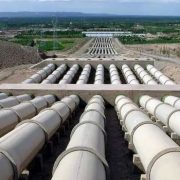
The corrosion of above-ground pipelines is caused by the combined action of corrosive ions (Cl-, S2-), CO2, bacteria and dissolved oxygen. Dissolved oxygen is a strong oxidant, it is easy to oxidize iron ions to form precipitation, and the relationship between dissolved oxygen and corrosion rate is linear. Sulfate-reducing bacteria will the existence of the sulfate-reducing hydrogen sulphide in the water, may lead to pipe hydrogen induced cracking and stress corrosion cracking, corrosion products generated ferrous sulfide and adhere on the surface of the steel is poor, easy to fall off, is potential, as the cathode constitute an active micro battery and steel matrix, and continue to produce corrosion to the steel substrate. Saprophytic bacteria adhere to the pipeline and cause fouling blockage, and also produce oxygen concentration cells and cause pipeline corrosion. The oil-water mixture in the surface pipeline may enter the sewage tank after separation. Therefore, when choosing anti-corrosion measures for the above-ground pipelines in the oil fields, the protection effect, construction difficulty, cost and other factors should be considered. Some commonly used anti-corrosion measures are for oil field above-ground pipelines:


Coating

There are many anticorrosive coatings on pipelines, and their performance is different. Choosing appropriate coatings can greatly extend the service life of pipelines. According to the corrosive environment, transport media and other conditions to choose the appropriate coating. The outer protective coating is the first and most important barrier of the above-ground steel pipe, mainly organic coating and metal coating (or coating). Organic coatings can be divided into epoxy resin, modified phenolic epoxy, asphalt, coal tar and other coatings. The experimental results show that the surface of the coating does not bubble when soaked in brine and oil, and the coating meets the requirements of API RP 5L2 adhesion and peel test, indicating that the coating has good adhesion. The coating is heated at 250℃ for 30min and then cooled by water at room temperature. The coating surface has no peeling, no cracking, no bubble, no adhesion loss, etc., that is, the coating has good heat resistance. According to ASTM D522, ASTM D968 and other standards to carry out bending and wear tests, the coating also has good bending and wear resistance.


Cathodic protection

It is not easy to coat the internal surface for small diameter pipelines (pipe diameter less than 60mm), even if the coating is completed indoors, it is difficult to achieve 100% pinhole free. In addition, the inner wall coating is often subjected to wear in the process of use, so the use of cathodic protection can effectively reduce corrosion perforation. Sacrificial anode protection is the earliest cathodic protection method, which is simple to operate and does not require power supply. The sacrificial anode materials commonly used in China include magnesium, zinc, aluminum and their alloys.

The output current of the sacrificial anode depends on its shape and size. In the laboratory test of magnesium, zinc, an aluminum alloy of cathodic protection potential (relative to the copper/copper sulfate reference electrode), three types of alloy are accord with the requirement of oil and gas station cathodic protection specification (cathodic protective potential is 0.85 V or more), including aluminum alloy anode protective effect is best, magnesium anode and zinc alloy anode is poorer.


Special joint

The special joint is designed to solve the damage to the interface coating caused by pipe welding after coating. Methods include: using refractory insulation material and high-temperature coating; Or use a new type of high temperature heat insulation ceramic joint, which has good heat insulation performance and corrosion resistance, as well as in the temperature of drastic changes in the performance of the burst and permeability resistance, but the disadvantage is that the strength and toughness is poor. Laboratory tests show that under the conditions of drastic changes in temperature, the crack resistance and penetration resistance of the joint can meet the requirements. However, under the premise of ensuring the strength and toughness, the joint wall thickness is too thick, and the change of inner diameter will affect the normal construction of the pipeline. The use of refractory insulation materials and high-temperature coating joints can fully meet the requirements of use.
 

なぜデュプレックスステンレス鋼が原子力発電所の冷却水システムに使用されているのですか?

クリーンエネルギー源として、原子力発電は世界的な炭素排出削減に大きく貢献しています。冷却水配管システムは原子力発電所の安全運作の鍵となります。このシステムは直径やサイズが異なる数千フィートにも及ぶパイプで構成されています。このシステムはプラント設備を冷却するために信頼性の高い水供給を提供します。非安全な配管システムはプラントの冷却に必要な十分な水供給を確保しなければならず、一方で安全システムは緊急事態が発生した場合に原子炉を制御し安全に停止させるための十分な冷却水供給を確保しなければなりません。

これらのパイプ材料は、機器の耐用期間を通じて冷却水による腐食に対して耐性を持つ必要があります。プラントの設置場所によっては、冷却水の種類は比較的清潔な淡水から汚染された海水までさまざまです。経験からいえるところでは、システムが経年劣化するにつれて、様々な腐食問題が生じ、その程度もさまざまとなり、システムを損傷させ、必要な冷却水を提供できなくなります。

冷却水配管の問題には、材料とその冷却水との相互作用が関係しています。汚染(詰まり)やシステムの腐食による漏れが最も一般的な問題です。これには堆積物の蓄積、海洋生物の付着(バイオフローリング)、腐食物質の蓄積、異物の詰まりなどが含まれます。漏れは通常、微生物による腐食(MIC)によって引き起こされます。これは、水中の特定の微生物によって引き起こされる非常に腐食性の腐食です。このタイプの腐食は、炭素鋼および低合金ステンレス鋼によく見られます。

ステンレス鋼は、新しい給水配管システムの建設や、既存の炭素鋼製システムを修理または交換する際に、長年にわたり実用的な選択肢とされてきました。配管のアップグレードソリューションに使用されるステンレス鋼は、一般的に304L、316L、または6%-Moステンレス鋼です。316Lと6% -Moステンレス鋼の性能と価格には大きな違いがあります。冷却媒体が未処理水である場合(非常に腐食性が高く、微生物による腐食のリスクがある)、304Lおよび316Lは適切な選択肢ではありません。その結果、原子力発電所では6%-Moステンレス鋼へのアップグレードが必要になったり、炭素鋼系システムの高いメンテナンスコストを余儀なくされたりしています。一部の原子力発電所では、初期コストが低いため、炭素鋼製配管をそのまま使用している場合もあります。ASTM A240によると、産業用給水配管システムは通常、以下のステンレス鋼製のものとなっています:

成績 UNS C N Cr ニ モ Cu
304L S30403 0.03 / 18.0-20.0 8.0-12.0 / /
316L S31603 0.03 / 16.0-18.0 10.0-14.0 2.0-3.0 /
6%Mo N08367 0.03 0.18-0.25 20.0-22.0 23.0-25.0 6.0-7.0 0.75
2205 S32205 0.03 0.14-0.2 22.0-23.0 4.5-6.5 3.0-3.5 /

2205デュプレックスステンレス鋼は優れた選択肢であることが証明されました。サウスカロライナ州のデューク・パワー社のキャタボア原子力発電所は、システム内で2205(UNS S32205)デュアルフェーズステンレス鋼を使用する初の原子力発電所です。このグレードには約3.2% モリブデンが含まれ、304Lおよび316Lステンレス鋼よりも耐食性および微生物による腐食に対する耐性が大幅に向上しています。

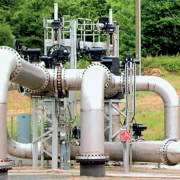
主コンデンサーの冷却塔への給水用の地上部分の配管システムにおける炭素鋼管は、2205デュプレックスステンレス鋼管に交換されました。

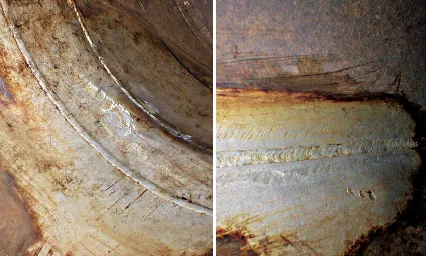
新しい代替品 2205 デュプレックスステンレス鋼管は2002年に設置されました。管の長さは60メートル、直径は76.2cmと91.4cm、壁厚は0.95cmです。管の仕様はASME B31.1 Power Pipingに従っており、これは発電所配管システムの安全な使用に関する管理規定の一つで、世界中で広く使用されています。500日間の使用を経て、管は徹底的に検査されました。検査中にはスケールや腐食は見られませんでした。2205デュプレックスステンレス鋼は非常に良好な性能を発揮しました。2205ステンレス鋼管は、設置以来10年以上も良好な性能を発揮しています。この経験に基づき、Duke Powerは2205ステンレス鋼管を使用しています。 2205デュプレックスステンレス鋼パイプ そのシステムの他の部分でも同様です。

2205パイプ内部、500日使用後の様子。


原子力発電所の水系設計者は、耐腐食性冷却水用の配管材料を選択する際に、もう一つの選択肢を持つようになりました。2205デュプレックスステンレス鋼の成功した適用により、メンテナンスコストを削減し、ダウンタイムを短縮し、原子力発電所の運転安全性を確保できます。

Uステンレス鋼熱交換器の熱処理

When talking about the heat treatment of austenitic U-shaped stainless steel tubes, most people think it’s not necessary because of sensitization and high solution treatment temperature, it is easy to cause deformation of the pipe. In fact, the heat treatment of Austenitic stainless steel is inevitable, heat treatment can not change the structure of stainless steel tubes, but can change the processability.

For example, due to low carbon content, 304 stainless steel heat exchange tube is difficult when normalizing to make the surface roughness of the gear shaping cutter to meet the requirements, reduce the tool life. The low carbon martensite and iron cable structure obtained after incomplete quenching can greatly improve the hardness and surface roughness, and the service life of the pipe can also be increased by 3 ~ 4 times. In addition, the u-shaped heat exchange tube bending part has a small bending radius and obvious work hardening phenomenon, heat treatment is necessary, and compared with the whole equipment for heat treatment, austenitic stainless steel pipe solution heat treatment, pickling passivation is much simpler. In this paper, a series of tests have been taken on U-shaped tubes with different specifications, bending radius and heat treatment conditions, and the necessity of heat treatment for U-shaped tubes made of austenitic stainless steel has been analyzed.


Experimental materials:

304 stainless steel U-tube

Size: 19*2mm, bending radius: 40, 15, 190, 265, 340mm

Size: 25*2.5mm Bending radius: 40, 115, 190, 265, 340,mm

Heat treatment: untreated, subsolid solution treatment, solid solution treatment


Hardness Testing

The bending section of u-shaped heat exchange tube without heat treatment and subsolid solution treatment: with the decrease of bending radius, the hardness value increases. The hardness value of heat exchange tube after solution treatment (compared with that before bending) has no obvious change. This indicates that Austenitic stainless steel work hardening effect is obvious, and with the increase of deformation, the trend of work hardening increases.


Microscopic inspection

For the u-shaped bend section with a bending radius of 40mm: there are a lot of martensite and slip lines in the microstructure without heat treatment, and the equiaxed shape of austenite in the microstructure has completely disappeared (too much martensite will make the steel brittle). Most of the martensite in the subsolid solution treated tissue has been transformed, but a small amount of martensite still exists.

After solution treatment, the austenite grains were equiaxed and no martensite was found. The slip bands and martensite also existed in the unheated microstructure of u-shaped tubes with bending radius R of 115, 190, 265 and 340mm after bending, but the content decreased gradually with the increase of bending radius. When the bending radius R of the U-shaped tube is greater than or equal to 265mm, the effect on the microstructure before and after heat treatment is not significant. When the bending radius R is less than 265mm, there is martensite in the microstructure of unheated U-shaped tubes, and the content of martensite decreases with the increase of heat treatment temperature (subsolid solution treatment and solid solution treatment).


Intergranular corrosion test

By microscopic examination, it was found that the presence of martensite did not affect intergranular corrosion. Although there is a large amount of martensite in the absolutized microstructure, there is no tendency of intergranular corrosion along with the distribution of martensite. Some grain boundaries widened before and after solution treatment, and the distribution of grain boundaries widened was independent of the distribution of martensite. On the basis of microscopic examination after the corrosion test, the bending test was carried out for u-shaped tubes in various states according to the test standard. No intergranular corrosion cracks were found in the tubes after bending 180°.


Solution treatment temperature

The effect of solution treatment is affected by the low solution temperature, and the results of microstructure and hardness can not be obtained. If the temperature is slightly higher, defects such as concave or crack may appear inside the U-shaped segment.


From the experiment, it is known that the martensite transformation of stainless steel after cold processing, the influence of corrosion resistance is far greater than the stress. When the bending radius of the u-shaped tube is less than 115mm, the microstructure of the u-shaped tube before and after solution treatment is significantly different. For this small radius U-shaped pipe bend segment, solid solution treatment should be performed after cold forming. If there is no requirement for higher intergranular corrosion resistance, it is recommended that the u-shaped bending section with a bending radius less than or equal to 265mm be treated with solution treatment (note to eliminate residual stress). For u-shaped heat exchange tubes with large radius curvature, the bending section may not be treated with solution, except for stress corrosion sensitive environments. Because the small pipe diameter fluid resistance is large, it is inconvenient to clean and easy to block the structure, and the large diameter stainless steel pipe fluid resistance is not as large as the small pipe diameter, easy to clean, more used for viscous or dirty fluid.


WLD Company can provide 304/316 stainless steel heat exchange tubes from 10mm to 114mm, the thickness of 0.6mm to 3.0mm; The length can be customized according to your actual working conditions. If you need it please contact us today.

The polishing treatment on stainless steel tube

The polishing treatment of stainless steel tubes is actually a surface grinding process, through the instrument and stainless steel tube surface friction to obtain a bright surface. Stainless steel tube outside polishing is used to cut the surface with different coarse particle size linen wheel to obtain the bright surface, and the internal polishing is in the stainless steel tube inside the reciprocating or selective movement of the internal grinding with plastic grinding head. It is worth noting that polishing can not improve the original machining accuracy but only change the surface flatness, the surface roughness value of polished stainless steel tube can reach 1.6-0.008um. According to the processing process, can be divided into mechanical abandonment and chemical polishing.


Mechanical polishing

Wheel polishing: The use of the flexible polishing wheel and fine abrasive on the surface of the steel pipe roll and micro-cutting to achieve the polishing process. The polishing wheel is made of overlapping layers of canvas, felt or leather, used for polishing large workpieces.

Roller polishing and vibration polishing is to put the workpiece, abrasive and polishing fluid into the drum or vibration box, the drum slowly rolling or vibration box vibration makes the workpiece and abrasive friction, polishing liquid chemical reaction can remove the steel pipe surface stains, corrosion, and burr to obtain a smooth surface. It’s suitable for large workpieces. The grinding resistance is related to the grinding machinery, the rigidity of the workpiece, and also has a relationship with the grinding vibration amplitude or grinding temperature, which affects the life of the grinding tool and the character of the grinding surface. The grinding temperature will cause the thermal deformation of the workpiece, reduce the dimensional accuracy, and also affect the processing metamorphic layer of the grinding surface.

Chemical polishing

The stainless steel tube is immersed in a special chemical solution. The phenomenon that the raised part of the metal surface dissolves faster than the concave part is used to achieve the process of polishing.

Chemical polishing is less investment, fast speed, high efficiency, good corrosion resistance; However, there are also brightness differences, gas overflow needs ventilation equipment, heating difficulties, suitable for complex parts and small parts of the light intensity requirements are not high products.

Electrolytic polishing

Electrolytic anode polishing on stainless steel tube is the process insoluble metal as the cathode, the poles into the electrochemical trough at the same time, through direct current (dc) and selective anodic dissolution, so stainless steel tube surface to achieve high brightness and luster appearance, and form – a sticky film on the surface, enhance the corrosion resistance of the pipe, applicable to occasions with higher requirements for surface quality.

Mirror polishing

Stainless steel mirror processing is actually a kind of polishing process, to the ステンレス鋼パイプ through the grinder counterclockwise rotation, correction wheel drive workpiece rotation, pressure on the pipe in the way of gravity pressure, In the matching grinding emulsion (mainly metal oxide, inorganic acid, organic lubricant and weak alkaline cleaning agent melt), stainless steel decorative tube and grinding disk for relative operation friction to achieve the purpose of grinding and polishing. The grade of polishing is divided into ordinary polishing, 6K, 8K, 10K, of which 8K grinding has been widely used because of the low process cost.

The weight chart of stainless steel square and rectangle tube

The stainless steel offers good corrosion resistance against most common chemical corrodents and industrial atmospheres. The stainless square or rectangle tubes have the advantages of long service life, good corrosion resistance and lightweight can be used in industrial piping, automotive, instrumentation, medical and construction industries, such as stair handrails, railings, partitions, bicycles, medical equipment, cars and so on. Here is the weight chart of 304 square and rectangle tubing:

304 Stainless steel square and rectangle tubing weight 

Length:6000mm, Unit:KG

サイズ 0.4 0.5 0.6 0.7 0.8 0.9 1 1.2 1.5 2 2.5 3 4 5
10×10 0.74 0.91 1.09 1.26 1.43 1.59
12×12 0.89 1.1 1.32 1.53 1.73 1.93 2.13 2.53
15×15 1.12 1.39 1.66 1.92 2.19 2.45 2.71 3.21 3.95
18×18 1.35 1.68 2 2.32 2.64 2.96 3.28 3.9 4.8
19×19 1.42 1.77 2.12 2.46 2.8 3.13 3.47 4.12 5.09 6.63
20×20 1.5 1.87 2.23 2.59 2.95 3.3 3.66 4.35 5.37 7.01
22×22 2.06 2.46 2.86 3.25 3.65 4.04 4.81 5.94 7.78
23×11 1.58 1.89 2.19 2.49 2.79 3.09 3.67 4.52 5.87
23×23 2.15 2.57 2.99 3.14 3.82 4.23 5.04 6.23 8.16
24×12 1.77 2.12 2.46 2.8 3.13 3.47 4.12 5.09 6.63
24×24 2.25 2.69 3.12 3.56 3.99 4.42 5.27 6.51 8.54
25×25 2.34 2.8 3.26 3.71 4.16 4.61 5.49 6.8 8.92
28×28 2.63 3.14 3.66 4.17 4.67 5.18 6.18 7.66 10.06
30×30 2.82 3.37 3.92 4.47 5.02 5.56 6.64 8.23 10.82
36×23 2.77 2.31 3.86 4.4 4.93 5.46 6.52 8.08 10.63
36×36 3.39 4.06 4.72 5.38 6.04 6.7 8.01 9.94 13.1
38×38 4.99 5.69 6.39 7.08 8.46 10.51 13.86
40×40 5.26 5.99 6.73 7.46 8.92 11.08 14.63
48×23 4 4.66 5.31 5.96 6.61 7.89 9.8 12.91
48×48 6.32 7.21 8.1 8.98 10.75 13.37 17.67
50×50 6.59 7.52 8.44 9.37 11.2 13.94 18.43 22.85
20×10 1.12 1.39 1.66 1.92 2.19 2.45 2.71 3.21
25×13 1.42 1.77 2.12 2.46 2.8 3.13 3.47 4.12 5.09 6.63
30×15 2.1 2.52 2.92 3.33 3.73 4.13 4.92 6.09 7.97
38×25 3.54 4.12 4.7 5.27 5.84 6.98 8.66 11.39
40×10 2.8 3.26 3.71 4.16 4.61 5.49 6.8 8.92
40×20 3.37 3.92 4.47 5.02 5.56 6.64 8.23 10.82
50×25 4.23 4.92 5.61 6.3 6.99 8.35 10.37 13.67
60×30 5.92 6.76 7.59 8.41 10.06 12.51 16.53 20.47
75×45 7.92 9.04 10.16 11.27 13.49 16.79 22.24
55×13 3.83 4.46 5.08 5.7 6.32 7.55 9.37 12.34
60×40 6.59 7.52 8.44 9.37 11.2 13.94 18.43 22.85
60×60 7.92 9.04 10.16 11.27 13.49 16.79 22.24 27.61 32.91
70×30 6.59 7.52 8.44 9.37 11.2 13.94 18.43 22.85
73×43 7.65 8.73 9.81 10.89 13.03 16.22 21.48 26.66
80×40 10.16 11.27 13.49 16.79 22.24 27.61 32.91
80×60 11.87 13.17 15.77 19.64 26.04 32.37 38.62 50.89
80×80 13.58 15.07 18.05 22.5 29.85 37.13 44.33 58.5
95×45 11.87 13.17 15.77 19.64 26.04 32.37 38.62 50.89
100×40 13.17 15.77 19.64 26.04 32.37 38.62 50.89
100×50 14.12 16.91 21.07 27.95 34.75 41.47 54.7
120×60 20.34 25.35 33.66 41.88 50.04 66.12 81.9
150×100 35.34 46.98 58.53 70.02 92.76 115.2
100×100 22.62 28.21 37.46 46.64 55.74 73.73 91.41
150×150 42.48 56.52 70.43 84.29 111.79 138.99

Alloy20はニッケル系合金ですか、それともステンレス鋼ですか?

Alloy20 (N08020) is an Austenitic nickel-iron-chromium-based superalloy with excellent resistance to total, intergranular, pitting and crevice corrosion in chemicals containing chlorides, sulfuric acid, phosphoric acid and nitric acid. Its corrosion resistance is good between 316L and Hastelloy, and it is not as good as 316L stainless steel in some amine solutions because it is easy to form nickel ammonium complexes.

In addition, it has a good cold forming and weldability even at up to 500℃. The low carbon content and the addition of niobium help to reduce the precipitation of carbides in the HEAT affected zone, so it can be used in the welded state in most cases.

For a long time, many people have been arguing: Is Alloy 20 a stainless steel or a nickel Alloy? Because their 32-38% nickel content is just close to 36%, the boundary between stainless steel and nickel-based alloys blurs the classification of materials. In general, it is true that alloy20 is a nickel alloy. The new edition of ASTM A240 includes alloy 20, which supports that alloys 20 have been classified as stainless steel from the side. Alloy20 plates are in accordance with ASTM B463, ASME SB463. The same materials as N08904 (904L), N08926(1.4529), etc., were early classified in the ASTM B nickel alloy standard series.


Alloy20 has the common characteristics of nickel alloy in terms of welding properties, that is, generally does not produce cold cracks when welding, and is more prone to produce hot cracks. Because of nickel and sulfur, phosphorus can form low melting eutectic, solidification often forms a thick dendritic austenite crystal, low melting point impurity is more likely to focus on grain boundary, the grain size and the effect of solidification shrinkage stress and welding stress, not entirely solidification grain boundary of low melting point material is easy to cracking formation of hot crack, so should strictly control the sulfur and phosphorus content of welding material.

Alloy 20 has excellent resistance to stress corrosion cracking, good resistance to local corrosion, satisfactory corrosion resistance in many chemical process media, chlorine gas and all kinds of media containing chloride, dry chlorine gas, formic and acetic acid, anhydride, seawater and saltwater, etc. At the same time, 20 alloy oxidation-reducing composite media corrosion, is often used in a sulfuric acid environment and containing halogen ions and metal ions sulfuric acid solution applications, such as hydrometallurgy and sulfuric acid industrial equipment.

First developed in 1951 for application in sulfuric acid, alloy 20 is the preferred alloy for sulfuric acid industrial environments. In 20% ~ 40% boiling sulfuric acid, it shows excellent resistance to stress corrosion cracking, and is an excellent material for many industries such as the chemical industry, food industry, pharmaceutical industry and plastics. It can be used in heat exchangers, mixing tanks, metal cleaning and pickling equipment and pipelines. Alloy 20 can also be applied in synthetic rubber manufacturing equipment, pharmaceuticals, plastics, organic and heavy chemical processing, storage tanks, pipes, heat exchangers, pumps, valves and other process equipment, pickling equipment, chemical process pipes, bubble caps, food and dye production is often used.