Pencegahan korosi pada saluran pipa di permukaan tanah

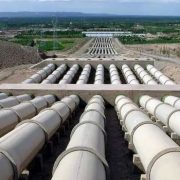
Kerusakan akibat korosi pipa bawah tanah Dihasilkan oleh kombinasi dari ion korosif (Cl-, S2-), CO2, bakteri, dan oksigen terlarut. Oksigen terlarut merupakan oksidator yang kuat, mudah mengoksidasi ion besi sehingga membentuk endapan, dan hubungan antara oksigen terlarut dan tingkat korosi bersifat linier. Bakteri reduktif sulfat akan menghasilkan hidrogen sulfida yang mengurangi sulfat dalam air, hal ini dapat menyebabkan retak hidrogen yang disebabkan oleh pipa dan retak korosi akibat stres, produk korosi yang dihasilkan berupa sulfida besi dan melekat pada permukaan baja, sangat sulit terlepas, berpotensi sebagai katoda yang membentuk baterai mikro aktif dan matriks baja, serta terus menghasilkan korosi pada substrat baja. Bakteri saprophit menempel pada pipa dan menyebabkan penyumbatan, serta menghasilkan sel-sel konsentrasi oksigen dan menyebabkan korosi pada pipa. Campuran minyak-air di dalam pipa permukaan dapat memasuki tangki limbah setelah dipisahkan. Oleh karena itu, saat memilih langkah-langkah anti-korosi untuk saluran pipa di permukaan tanah di ladang minyak, perlu dipertimbangkan efek perlindungan, kesulitan konstruksi, biaya, dan faktor-faktor lainnya. Beberapa langkah anti-korosi yang umum digunakan untuk saluran pipa di permukaan tanah di ladang minyak adalah sebagai berikut:


Pelapisan

Ada banyak lapisan anti-korosi pada pipa, dan fungsinya berbeda-beda. Memilih lapisan yang tepat dapat sangat memperpanjang umur pakai pipa. Menurut lingkungan korosif, media transportasi, dan kondisi lainnya, pilihlah lapisan yang sesuai. Lapisan pelindung luar adalah penghalang pertama dan paling penting dari pipa baja di permukaan tanah, terutama lapisan organik dan lapisan logam (atau lapisan). Lapisan organik dapat dibagi menjadi resin epoksi, epoksi fenolik modifikasi, aspal, tar batubara, dan lapisan lainnya. Hasil uji menunjukkan bahwa permukaan lapisan tidak akan bergelombang saat direndam dalam air garam dan minyak, dan lapisan tersebut memenuhi persyaratan API RP 5L2 dalam uji adhesi dan retak, menunjukkan bahwa lapisan tersebut memiliki ketahanan panas yang baik. Lapisan dipanaskan pada suhu 250°C selama 30 menit dan kemudian didinginkan dengan air pada suhu kamar. Permukaan lapisan tidak akan terkelupas, tidak retak, tidak bergelombang, tidak kehilangan adhesi, dll., yaitu, lapisan tersebut memiliki ketahanan panas yang baik. Menurut ASTM D522, ASTM D968 dan standar lainnya untuk melakukan uji lentur dan aus, lapisan tersebut juga memiliki ketahanan lentur dan aus yang baik.


Pelindungan katodik

Tidak mudah untuk melapisi permukaan internal untuk pipa berdiameter kecil (diameter pipa kurang dari 60mm), bahkan jika pelapisan tersebut dilakukan di dalam ruangan, sulit untuk mencapai tingkat bebas lubang 100%. Selain itu, lapisan dinding bagian dalam sering mengalami keausan dalam proses penggunaannya, sehingga penggunaan perlindungan katodik dapat secara efektif mengurangi kerusakan korosi. Perlindungan anoda suci adalah metode perlindungan katodik paling awal, yang mudah dioperasikan dan tidak memerlukan pasokan listrik. Bahan anoda suci yang umumnya digunakan di China meliputi magnesium, seng, aluminium dan paduan mereka.

Arus keluaran dari anoda korosif tergantung pada bentuk dan ukuran anoda tersebut. Dalam uji laboratorium terhadap magnesium, seng, dan paduan aluminium dengan potensi perlindungan katodik (berbanding dengan elektroda referensi tembaga/sulfat tembaga), tiga jenis paduan tersebut memenuhi persyaratan spesifikasi perlindungan katodik untuk stasiun minyak dan gas (potensi perlindungan katodik adalah 0,85 V atau lebih). Efek perlindungan anoda dari paduan aluminium terbaik, sedangkan anoda magnesium dan anoda paduan seng lebih buruk.


Joint khusus

Joint khusus ini dirancang untuk mengatasi kerusakan lapisan sambungan akibat pengelasan pipa setelah pelapisan. Metode tersebut meliputi: menggunakan bahan isolasi tahan api dan lapisan bertekanan tinggi; atau menggunakan jenis baru keramik sambungan isolasi panas bertekanan tinggi, yang memiliki kinerja isolasi panas dan ketahanan korosi yang baik, serta dalam kondisi perubahan suhu yang drastis terhadap kinerja terhadap pecah dan ketahanan permeabilitas, namun kelemahannya adalah kekuatan dan ketangguhan yang buruk. Uji laboratorium menunjukkan bahwa dalam kondisi perubahan suhu yang drastis, ketahanan retak dan ketahanan penetrasi dari joint tersebut dapat memenuhi persyaratan. Namun, dengan mempertimbangkan aspek kekuatan dan ketangguhan, ketebalan dinding joint terlalu tebal, dan perubahan diameter bagian dalam akan mempengaruhi konstruksi normalnya. pipaPenggunaan bahan isolasi tahan api dan sambungan pelapisan suhu tinggi dapat memenuhi sepenuhnya persyaratan penggunaan.
 

Mengapa baja stainless dua lapisan digunakan dalam sistem pendingin air pembangkit listrik tenaga nuklir?

Sebagai sumber energi bersih, tenaga nuklir merupakan kontributor utama dalam mengurangi emisi karbon di seluruh dunia. Sistem pipa pendingin merupakan kunci keberhasilan operasi sebuah pembangkit listrik tenaga nuklir. Sistem ini terdiri dari ribuan meter pipa dengan berbagai diameter dan ukuran. Ia menyediakan pasokan air yang andal untuk mendinginkan peralatan pabrik. Sistem pipa non-safety harus menyediakan air pendingin yang cukup untuk mendinginkan pabrik, sedangkan sistem keselamatan harus menyediakan air pendingin yang cukup untuk mengendalikan reaktor dan mematikannya dengan aman jika terjadi keadaan darurat.

Bahan pipa ini harus tahan terhadap korosi air pendingin selama masa pakai peralatan. Tergantung pada lokasi pabrik, jenis air pendingin dapat berkisar dari air tawar yang relatif bersih hingga air laut yang tercemar. Pengalaman menunjukkan bahwa seiring berjalannya waktu, berbagai masalah korosi dan tingkat korosi yang berbeda dapat terjadi, merusak sistem dan mencegahnya memberikan air pendingin yang dibutuhkan.

Masalah dengan saluran air pendingin seringkali terkait dengan bahan dan interaksinya dengan air pendingin. Kebocoran akibat terkumpulnya endapan (plak) dan korosi pada sistem merupakan masalah yang paling umum, termasuk akumulasi sedimen, penempelan organisme laut (biofouling), akumulasi produk korosi, dan penyumbatan oleh benda asing. Kebocoran biasanya disebabkan oleh korosi mikroba (MIC), yang merupakan korosi sangat korosif yang disebabkan oleh mikroorganisme tertentu dalam air. Bentuk korosi ini sering terjadi pada baja karbon dan baja stainless yang memiliki kandungan paduan rendah.

Keluli tahan karat telah lama dianggap sebagai pilihan yang layak untuk membina sistem paip bekalan air baharu dan untuk membaiki atau menggantikan sistem keluli karbon yang sedia ada. Keluli tahan karat yang lazim digunakan dalam penyelesaian peningkatan paip ialah keluli tahan karat 304L, 316L atau 6%-Mo. Keluli tahan karat 316L dan 6% -Mo mempunyai perbezaan besar dalam prestasi dan harga. Sekiranya medium penyejukan adalah air yang tidak dirawat, yang sangat korosif dan membawa risiko kerosakan mikrobial, keluli tahan karat 304L dan 316L tidak sesuai. Akibatnya, loji tenaga nuklear terpaksa menaik taraf kepada keluli tahan karat 6%-Mo atau menerima kos penyelenggaraan yang tinggi bagi sistem keluli karbon. Sesetengah loji tenaga nuklear masih menggunakan paip lapisan keluli karbon kerana kos permulaan yang lebih rendah. Menurut ASTM A240, sistem paip bekalan air industri lazimnya diperbuat daripada keluli tahan karat seperti berikut:

Nilai UNS C N Cr Ni Mo Cu
304L S30403 0.03 / 18.0-20.0 8.0-12.0 / /
316L S31603 0.03 / 16.0-18.0 10.0-14.0 2.0-3.0 /
6%Mo N08367 0.03 0.18-0.25 20.0-22.0 23.0-25.0 6.0-7.0 0.75
2205 S32205 0.03 0.14-0.2 22.0-23.0 4.5-6.5 3.0-3.5 /

Tembaga padu 2205 terbukti menjadi pilihan yang sangat baik. Pembangkit listrik nuklir Catawba milik Duke Power di Carolina Selatan adalah pembangkit listrik nuklir pertama yang menggunakan tembaga padu 2205 (UNS S32205) dalam sistemnya. Kelas ini mengandung sekitar 3,2% molibdenum dan memiliki ketahanan korosi yang lebih baik serta ketahanan korosi mikroba yang jauh lebih baik dibandingkan dengan baja stainless 304L dan 316L.

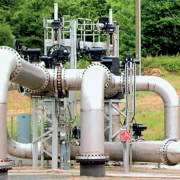
Pipa pelindung baja karbon pada bagian atas sistem pipa yang mengalirkan air pasokan ke menara pendingin kondenser utama diganti dengan pipa stainless steel dupleks 2205.

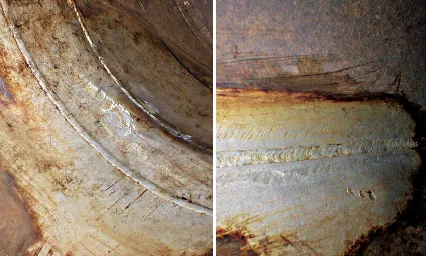
Pengganti baru 2205 Pipa stainless steel dupleks dipasang pada tahun 2002. Pipa tersebut berukuran panjang 60 meter, diameter 76,2 cm dan 91,4 cm, dan ketebalan dinding pipa adalah 0,95 cm. Sistem tersebut ditetapkan sesuai dengan ASME B31.1 Power Piping, yang merupakan salah satu kode manajemen untuk penggunaan yang aman dari sistem pipa pembangkit listrik dan banyak digunakan di seluruh dunia. Setelah 500 hari beroperasi, sistem tersebut telah diperiksa secara menyeluruh. Tidak ditemukan adanya pengkaratan atau korosi selama pemeriksaan tersebut. Pipa stainless steel dupleks 2205 berkinerja sangat baik. Pipa stainless steel 2205 telah berkinerja baik selama lebih dari satu dekade sejak pemasangannya. Berdasarkan pengalaman ini, Duke Power telah menggunakan Pipa stainless steel duplex 2205 di bagian lain dari sistemnya.

Hasil dari pipa 2205 setelah digunakan selama 500 hari.


Desainer sistem air pembangkit listrik tenaga nuklir kini memiliki satu opsi tambahan dalam memilih bahan pipa untuk air pendingin yang tahan korosi. Penggunaan dengan sukses dari baja stainless duplex 2205 dapat mengurangi biaya pemeliharaan, mengurangi waktu downtime, dan memastikan keamanan operasi pembangkit listrik tenaga nuklir.

The heat treatments of U stainless steel heat exchanger

When talking about the heat treatment of austenitic U-shaped stainless steel tubes, most people think it’s not necessary because of sensitization and high solution treatment temperature, it is easy to cause deformation of the pipe. In fact, the heat treatment of Austenitic stainless steel is inevitable, heat treatment can not change the structure of stainless steel tubes, but can change the processability.

For example, due to low carbon content, 304 stainless steel heat exchange tube is difficult when normalizing to make the surface roughness of the gear shaping cutter to meet the requirements, reduce the tool life. The low carbon martensite and iron cable structure obtained after incomplete quenching can greatly improve the hardness and surface roughness, and the service life of the pipe can also be increased by 3 ~ 4 times. In addition, the u-shaped heat exchange tube bending part has a small bending radius and obvious work hardening phenomenon, heat treatment is necessary, and compared with the whole equipment for heat treatment, austenitic stainless steel pipe solution heat treatment, pickling passivation is much simpler. In this paper, a series of tests have been taken on U-shaped tubes with different specifications, bending radius and heat treatment conditions, and the necessity of heat treatment for U-shaped tubes made of austenitic stainless steel has been analyzed.


Experimental materials:

304 stainless steel U-tube

Size: 19*2mm, bending radius: 40, 15, 190, 265, 340mm

Size: 25*2.5mm Bending radius: 40, 115, 190, 265, 340,mm

Heat treatment: untreated, subsolid solution treatment, solid solution treatment


Hardness Testing

The bending section of u-shaped heat exchange tube without heat treatment and subsolid solution treatment: with the decrease of bending radius, the hardness value increases. The hardness value of heat exchange tube after solution treatment (compared with that before bending) has no obvious change. This indicates that Austenitic stainless steel work hardening effect is obvious, and with the increase of deformation, the trend of work hardening increases.


Microscopic inspection

For the u-shaped bend section with a bending radius of 40mm: there are a lot of martensite and slip lines in the microstructure without heat treatment, and the equiaxed shape of austenite in the microstructure has completely disappeared (too much martensite will make the steel brittle). Most of the martensite in the subsolid solution treated tissue has been transformed, but a small amount of martensite still exists.

After solution treatment, the austenite grains were equiaxed and no martensite was found. The slip bands and martensite also existed in the unheated microstructure of u-shaped tubes with bending radius R of 115, 190, 265 and 340mm after bending, but the content decreased gradually with the increase of bending radius. When the bending radius R of the U-shaped tube is greater than or equal to 265mm, the effect on the microstructure before and after heat treatment is not significant. When the bending radius R is less than 265mm, there is martensite in the microstructure of unheated U-shaped tubes, and the content of martensite decreases with the increase of heat treatment temperature (subsolid solution treatment and solid solution treatment).


Intergranular corrosion test

By microscopic examination, it was found that the presence of martensite did not affect intergranular corrosion. Although there is a large amount of martensite in the absolutized microstructure, there is no tendency of intergranular corrosion along with the distribution of martensite. Some grain boundaries widened before and after solution treatment, and the distribution of grain boundaries widened was independent of the distribution of martensite. On the basis of microscopic examination after the corrosion test, the bending test was carried out for u-shaped tubes in various states according to the test standard. No intergranular corrosion cracks were found in the tubes after bending 180°.


Solution treatment temperature

The effect of solution treatment is affected by the low solution temperature, and the results of microstructure and hardness can not be obtained. If the temperature is slightly higher, defects such as concave or crack may appear inside the U-shaped segment.


From the experiment, it is known that the martensite transformation of stainless steel after cold processing, the influence of corrosion resistance is far greater than the stress. When the bending radius of the u-shaped tube is less than 115mm, the microstructure of the u-shaped tube before and after solution treatment is significantly different. For this small radius U-shaped pipe bend segment, solid solution treatment should be performed after cold forming. If there is no requirement for higher intergranular corrosion resistance, it is recommended that the u-shaped bending section with a bending radius less than or equal to 265mm be treated with solution treatment (note to eliminate residual stress). For u-shaped heat exchange tubes with large radius curvature, the bending section may not be treated with solution, except for stress corrosion sensitive environments. Because the small pipe diameter fluid resistance is large, it is inconvenient to clean and easy to block the structure, and the large diameter stainless steel pipe fluid resistance is not as large as the small pipe diameter, easy to clean, more used for viscous or dirty fluid.


WLD Company can provide 304/316 stainless steel heat exchange tubes from 10mm to 114mm, the thickness of 0.6mm to 3.0mm; The length can be customized according to your actual working conditions. If you need it please contact us today.

The polishing treatment on stainless steel tube

The polishing treatment of stainless steel tubes is actually a surface grinding process, through the instrument and stainless steel tube surface friction to obtain a bright surface. Stainless steel tube outside polishing is used to cut the surface with different coarse particle size linen wheel to obtain the bright surface, and the internal polishing is in the stainless steel tube inside the reciprocating or selective movement of the internal grinding with plastic grinding head. It is worth noting that polishing can not improve the original machining accuracy but only change the surface flatness, the surface roughness value of polished stainless steel tube can reach 1.6-0.008um. According to the processing process, can be divided into mechanical abandonment and chemical polishing.


Pemolesan mekanis

Wheel polishing: The use of the flexible polishing wheel and fine abrasive on the surface of the steel pipe roll and micro-cutting to achieve the polishing process. The polishing wheel is made of overlapping layers of canvas, felt or leather, used for polishing large workpieces.

Roller polishing and vibration polishing is to put the workpiece, abrasive and polishing fluid into the drum or vibration box, the drum slowly rolling or vibration box vibration makes the workpiece and abrasive friction, polishing liquid chemical reaction can remove the steel pipe surface stains, corrosion, and burr to obtain a smooth surface. It’s suitable for large workpieces. The grinding resistance is related to the grinding machinery, the rigidity of the workpiece, and also has a relationship with the grinding vibration amplitude or grinding temperature, which affects the life of the grinding tool and the character of the grinding surface. The grinding temperature will cause the thermal deformation of the workpiece, reduce the dimensional accuracy, and also affect the processing metamorphic layer of the grinding surface.

Pembersihan kimia

The stainless steel tube is immersed in a special chemical solution. The phenomenon that the raised part of the metal surface dissolves faster than the concave part is used to achieve the process of polishing.

Chemical polishing is less investment, fast speed, high efficiency, good corrosion resistance; However, there are also brightness differences, gas overflow needs ventilation equipment, heating difficulties, suitable for complex parts and small parts of the light intensity requirements are not high products.

Pemolesan elektrokimia

Electrolytic anode polishing on stainless steel tube is the process insoluble metal as the cathode, the poles into the electrochemical trough at the same time, through direct current (dc) and selective anodic dissolution, so stainless steel tube surface to achieve high brightness and luster appearance, and form – a sticky film on the surface, enhance the corrosion resistance of the pipe, applicable to occasions with higher requirements for surface quality.

Mirror polishing

Stainless steel mirror processing is actually a kind of polishing process, to the stainless steel pipe through the grinder counterclockwise rotation, correction wheel drive workpiece rotation, pressure on the pipe in the way of gravity pressure, In the matching grinding emulsion (mainly metal oxide, inorganic acid, organic lubricant and weak alkaline cleaning agent melt), stainless steel decorative tube and grinding disk for relative operation friction to achieve the purpose of grinding and polishing. The grade of polishing is divided into ordinary polishing, 6K, 8K, 10K, of which 8K grinding has been widely used because of the low process cost.

The weight chart of stainless steel square and rectangle tube

The stainless steel offers good corrosion resistance against most common chemical corrodents and industrial atmospheres. The stainless square or rectangle tubes have the advantages of long service life, good corrosion resistance and lightweight can be used in industrial piping, automotive, instrumentation, medical and construction industries, such as stair handrails, railings, partitions, bicycles, medical equipment, cars and so on. Here is the weight chart of 304 square and rectangle tubing:

304 Stainless steel square and rectangle tubing weight 

Length:6000mm, Unit:KG

Ukuran 0.4 0.5 0.6 0.7 0.8 0.9 1 1.2 1.5 2 2.5 3 4 5
10×10 0.74 0.91 1.09 1.26 1.43 1.59
12×12 0.89 1.1 1.32 1.53 1.73 1.93 2.13 2.53
15×15 1.12 1.39 1.66 1.92 2.19 2.45 2.71 3.21 3.95
18×18 1.35 1.68 2 2.32 2.64 2.96 3.28 3.9 4.8
19×19 1.42 1.77 2.12 2.46 2.8 3.13 3.47 4.12 5.09 6.63
20×20 1.5 1.87 2.23 2.59 2.95 3.3 3.66 4.35 5.37 7.01
22×22 2.06 2.46 2.86 3.25 3.65 4.04 4.81 5.94 7.78
23×11 1.58 1.89 2.19 2.49 2.79 3.09 3.67 4.52 5.87
23×23 2.15 2.57 2.99 3.14 3.82 4.23 5.04 6.23 8.16
24×12 1.77 2.12 2.46 2.8 3.13 3.47 4.12 5.09 6.63
24×24 2.25 2.69 3.12 3.56 3.99 4.42 5.27 6.51 8.54
25×25 2.34 2.8 3.26 3.71 4.16 4.61 5.49 6.8 8.92
28×28 2.63 3.14 3.66 4.17 4.67 5.18 6.18 7.66 10.06
30×30 2.82 3.37 3.92 4.47 5.02 5.56 6.64 8.23 10.82
36×23 2.77 2.31 3.86 4.4 4.93 5.46 6.52 8.08 10.63
36×36 3.39 4.06 4.72 5.38 6.04 6.7 8.01 9.94 13.1
38×38 4.99 5.69 6.39 7.08 8.46 10.51 13.86
40×40 5.26 5.99 6.73 7.46 8.92 11.08 14.63
48×23 4 4.66 5.31 5.96 6.61 7.89 9.8 12.91
48×48 6.32 7.21 8.1 8.98 10.75 13.37 17.67
50×50 6.59 7.52 8.44 9.37 11.2 13.94 18.43 22.85
20×10 1.12 1.39 1.66 1.92 2.19 2.45 2.71 3.21
25×13 1.42 1.77 2.12 2.46 2.8 3.13 3.47 4.12 5.09 6.63
30×15 2.1 2.52 2.92 3.33 3.73 4.13 4.92 6.09 7.97
38×25 3.54 4.12 4.7 5.27 5.84 6.98 8.66 11.39
40×10 2.8 3.26 3.71 4.16 4.61 5.49 6.8 8.92
40×20 3.37 3.92 4.47 5.02 5.56 6.64 8.23 10.82
50×25 4.23 4.92 5.61 6.3 6.99 8.35 10.37 13.67
60×30 5.92 6.76 7.59 8.41 10.06 12.51 16.53 20.47
75×45 7.92 9.04 10.16 11.27 13.49 16.79 22.24
55×13 3.83 4.46 5.08 5.7 6.32 7.55 9.37 12.34
60×40 6.59 7.52 8.44 9.37 11.2 13.94 18.43 22.85
60×60 7.92 9.04 10.16 11.27 13.49 16.79 22.24 27.61 32.91
70×30 6.59 7.52 8.44 9.37 11.2 13.94 18.43 22.85
73×43 7.65 8.73 9.81 10.89 13.03 16.22 21.48 26.66
80×40 10.16 11.27 13.49 16.79 22.24 27.61 32.91
80×60 11.87 13.17 15.77 19.64 26.04 32.37 38.62 50.89
80×80 13.58 15.07 18.05 22.5 29.85 37.13 44.33 58.5
95×45 11.87 13.17 15.77 19.64 26.04 32.37 38.62 50.89
100×40 13.17 15.77 19.64 26.04 32.37 38.62 50.89
100×50 14.12 16.91 21.07 27.95 34.75 41.47 54.7
120×60 20.34 25.35 33.66 41.88 50.04 66.12 81.9
150×100 35.34 46.98 58.53 70.02 92.76 115.2
100×100 22.62 28.21 37.46 46.64 55.74 73.73 91.41
150×150 42.48 56.52 70.43 84.29 111.79 138.99

Is Alloy20 a nickel-based alloy or stainless steel?

Alloy20 (N08020) is an Austenitic nickel-iron-chromium-based superalloy with excellent resistance to total, intergranular, pitting and crevice corrosion in chemicals containing chlorides, sulfuric acid, phosphoric acid and nitric acid. Its corrosion resistance is good between 316L and Hastelloy, and it is not as good as 316L stainless steel in some amine solutions because it is easy to form nickel ammonium complexes.

In addition, it has a good cold forming and weldability even at up to 500℃. The low carbon content and the addition of niobium help to reduce the precipitation of carbides in the HEAT affected zone, so it can be used in the welded state in most cases.

For a long time, many people have been arguing: Is Alloy 20 a stainless steel or a nickel Alloy? Because their 32-38% nickel content is just close to 36%, the boundary between stainless steel and nickel-based alloys blurs the classification of materials. In general, it is true that alloy20 is a nickel alloy. The new edition of ASTM A240 includes alloy 20, which supports that alloys 20 have been classified as stainless steel from the side. Alloy20 plates are in accordance with ASTM B463, ASME SB463. The same materials as N08904 (904L), N08926(1.4529), etc., were early classified in the ASTM B nickel alloy standard series.


Alloy20 has the common characteristics of nickel alloy in terms of welding properties, that is, generally does not produce cold cracks when welding, and is more prone to produce hot cracks. Because of nickel and sulfur, phosphorus can form low melting eutectic, solidification often forms a thick dendritic austenite crystal, low melting point impurity is more likely to focus on grain boundary, the grain size and the effect of solidification shrinkage stress and welding stress, not entirely solidification grain boundary of low melting point material is easy to cracking formation of hot crack, so should strictly control the sulfur and phosphorus content of welding material.

Alloy 20 has excellent resistance to stress corrosion cracking, good resistance to local corrosion, satisfactory corrosion resistance in many chemical process media, chlorine gas and all kinds of media containing chloride, dry chlorine gas, formic and acetic acid, anhydride, seawater and saltwater, etc. At the same time, 20 alloy oxidation-reducing composite media corrosion, is often used in a sulfuric acid environment and containing halogen ions and metal ions sulfuric acid solution applications, such as hydrometallurgy and sulfuric acid industrial equipment.

First developed in 1951 for application in sulfuric acid, alloy 20 is the preferred alloy for sulfuric acid industrial environments. In 20% ~ 40% boiling sulfuric acid, it shows excellent resistance to stress corrosion cracking, and is an excellent material for many industries such as the chemical industry, food industry, pharmaceutical industry and plastics. It can be used in heat exchangers, mixing tanks, metal cleaning and pickling equipment and pipelines. Alloy 20 can also be applied in synthetic rubber manufacturing equipment, pharmaceuticals, plastics, organic and heavy chemical processing, storage tanks, pipes, heat exchangers, pumps, valves and other process equipment, pickling equipment, chemical process pipes, bubble caps, food and dye production is often used.