La prévention de la corrosion des pipelines en surface

La corrosion de Les pipelines souterrains Il est causé par l’action combinée d’ions corrosifs (Cl-, S2-), de CO2, de bactéries et d’oxygène dissous. L’oxygène dissous est un puissant oxydant ; il est facile d’oxyder les ions ferreux pour former des précipitations ; la relation entre l’oxygène dissous et le taux de corrosion est linéaire. Les bactéries réduisant l’oxygène dissous retrouveront l’oxygène dissous dans l’eau, ce qui peut provoquer des fissures induites par l’hydrogène dans les tuyaux et des fissures de corrosion due à la contrainte ; les produits de corrosion générés par le fer dissous sont difficiles à éliminer et se déposent sur la surface de l’acier ; ils sont peu résistants à l’oxydation et tombent facilement ; ils sont potentiellement dangereux car ils constituent une microbatterie active et une matrice d’acier, et continuent à produire de la corrosion sur le substrat métallique. Les bactéries saprophytes adhèrent au pipeline et provoquent une obstruction, ainsi que la formation de cellules d’oxygène concentré ; cela peut également provoquer une corrosion de la matrice métallique et des fissures dans le pipeline. Le mélange huile-eau dans le pipeline peut pénétrer dans le réservoir d’eaux usées après la séparation. Par conséquent, lors du choix des mesures anti-corrosion pour les pipelines souterrains dans les gisements pétrolifères, il convient de prendre en considération l’effet de protection, la difficulté de construction, le coût et d’autres facteurs. Certaines mesures anti-corrosion couramment utilisées pour les pipelines souterrains dans les gisements pétrolifères sont les suivantes :


Couverture

De nombreux revêtements anticorrosion sont appliqués sur les pipelines, et leur performance varie. Choisir les revêtements appropriés peut considérablement prolonger la durée de vie des pipelines. En fonction de l’environnement corrosif, des milieux de transport et d’autres conditions, il convient de choisir les revêtements appropriés. Le revêtement extérieur est la première et la plus importante barrière de la tuyauterie souterraine en acier, composé principalement de revêtements organiques et métalliques (ou de revêtements). Les revêtements organiques peuvent être divisés en résine époxy, époxy phénolique modifié, asphalte, goudron de houille et autres revêtements. Les résultats expérimentaux montrent que la surface du revêtement ne présente pas de bulles lors de l’immersion dans l’eau de mer et l’huile, et que le revêtement satisfait aux exigences de l’API RP 5L2 en matière d’adhérence et de test de décollement, ce qui indique que le revêtement présente une bonne adhérence. Le revêtement est chauffé à 250 °C pendant 30 minutes puis refroidi à température ambiante par de l’eau. La surface du revêtement ne présente pas de décollement, de fissuration, de bulles, de perte d’adhérence, etc., c’est-à-dire que le revêtement présente une bonne résistance à la chaleur. Selon les normes ASTM D522, ASTM D968 et d'autres normes visant à effectuer des essais de flexion et d'usure, la couche de revêtement présente également une bonne résistance à la flexion et à l'usure.


Protection cathodique

Il n’est pas facile de revêtir la surface intérieure des pipelines de petit diamètre (diamètre des tubes inférieur à 60 mm). Même si la couche de revêtement est réalisée à l’intérieur, il est difficile d’obtenir une surface libre de trous de 100% piques. De plus, la couche de paroi intérieure est souvent exposée à l’usure lors de l’utilisation, de sorte que l’utilisation de la protection cathodique peut efficacement réduire les perforations dues à la corrosion. La protection cathodique sacrificielle est la méthode de protection cathodique la plus ancienne, facile à utiliser et ne nécessitant pas d’alimentation électrique. Les matériaux d’anode sacrificielle utilisés couramment en Chine comprennent le magnésium, le zinc, l’aluminium et leurs alliages.

La tension de sortie de l’anode sacrificielle dépend de sa forme et de sa taille. Lors des essais en laboratoire sur le magnésium, le zinc et l’alliage d’aluminium ayant un potentiel cathodique (par rapport à l’électrode de référence en cuivre/sulfate de cuivre), trois types d’alliages sont conformes aux exigences de la spécification de la protection cathodique des stations pétrolières et gazées (le potentiel cathodique de protection est de 0,85 V ou plus). L’alliage d’anode en aluminium présente le meilleur effet de protection, tandis que l’alliage d’anode en magnésium et l’alliage d’anode en zinc sont moins performants.


Joint spécial

Cette jointure spéciale est conçue pour remédier aux dommages causés par la soudure des tuyaux après la mise en œuvre de la couche de revêtement. Les méthodes comprennent : l’utilisation d’un matériau isolant réfractaire et d’un revêtement à haute température ; ou l’utilisation d’une nouvelle forme de joint en céramique à haute température à isolation thermique, qui présente d’excellentes performances d’isolation thermique et de résistance à la corrosion, ainsi qu’une bonne résistance à la chaleur et une bonne résistance à la corrosion dans les variations brusques de température ; toutefois, son inconvénient est que sa résistance à la rupture et sa résistance à la pénétration sont faibles. Les essais de laboratoire montrent que, dans les conditions de variations brusques de température, la résistance à la rupture et la résistance à la pénétration de la jointure peuvent satisfaire aux exigences ; toutefois, dans le cadre de la garantie de la résistance et de la ténacité, l’épaisseur de la paroi de la jointure est trop importante et le changement de diamètre intérieur affecte la réalisation normale de la structure. pipelineL’utilisation de matériaux isolants réfractaires et de joints de revêtement à haute température peut répondre pleinement aux exigences d’utilisation.
 

Why is duplex stainless steel used in nuclear power plant cooling water systems?

As a clean energy source, nuclear power is a major contributor to reducing carbon emissions worldwide. The cooling water piping system is the key to the safe operation of a nuclear power plant. It consists of thousands of feet of pipes of various diameters and sizes. It provides a reliable water supply for the cooling of plant equipment. The non-safety piping system must provide enough cooling water to cool the plant, while the safety system must provide enough cooling water to bring the reactor under control and safely shut it down in case of an emergency.

These pipe materials must be resistant to cooling water corrosion throughout the service life of the equipment. Depending on the plant’s location, the type of cooling water can range from relatively clean fresh water to contaminated seawater. Experience has shown that as systems age, a variety of corrosion problems and varying degrees of corrosion can occur, damaging the system and preventing it from providing the required cooling water.

Problems with cooling water piping often involve materials and their interactions with cooling water. Leakage from fouling (plugging) and corrosion of the system are the most common problems, including sediment accumulation, Marine biological attachment (biofouling), accumulation of corrosion products, and blockage of foreign matter. Leakage is usually caused by microbial corrosion (MIC), which is very corrosive corrosion caused by certain microorganisms in water. This form of corrosion occurs frequently in carbon steel and low-alloyed stainless steel.

Stainless steel has long been considered a viable option for building new water supply piping systems and for repairing or replacing existing carbon steel systems. The stainless steel commonly used in piping upgrade solutions is 304L, 316L, or 6%-Mo stainless steel. 316L and 6% Mo stainless steel yo big differences in performance and price. If the cooling medium is untreated water, which is highly corrosive and carries a risk of microbial corrosion, 304L and 316L are not suitable choices. As a result, nuclear plants have had to upgrade to 6%-Mo stainless steel or accept the high maintenance costs of carbon steel systems. Some nuclear power plants still use carbon steel lining pipes because of the lower initial cost. According to ASTM A240,Industrial water supply piping systems are often made of stainless steel below:

Notes UNS C N Cr Ni Mo Cu
304L S30403 0.03 / 18.0-20.0 8.0-12.0 / /
316L S31603 0.03 / 16.0-18.0 10.0-14.0 2.0-3.0 /
6%Mo N08367 0.03 0.18-0.25 20.0-22.0 23.0-25.0 6.0-7.0 0.75
2205 S32205 0.03 0.14-0.2 22.0-23.0 4.5-6.5 3.0-3.5 /

The 2205 duplex stainless steel proved to be an excellent choice. Duke Power’s Catawba nuclear power plant in South Carolina is the first nuclear power plant to use 2205 (UNS S32205) dual-phase stainless steel in its systems. This grade contains approximately 3.2% molybdenum and has improved corrosion resistance and significantly better microbial corrosion resistance than 304L and 316L stainless steels.

The carbon steel lining piping on the overground portion of the piping system conveying the supply water to the cooling tower of the main condenser was replaced with 2205 duplex stainless steel piping.

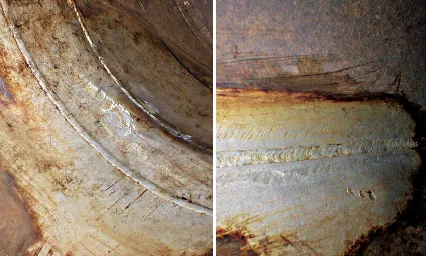
The new replacement 2205 duplex stainless steel pipe was installed in 2002. The pipe is 60 meters long, 76.2 cm and 91.4 cm in diameter, and the wall thickness of the pipe is 0.95 cm. The system specified in accordance with ASME B31.1 Power piping, which is one of the management codes for the safe use of power plant piping systems and is widely used in the world. After 500 days of service, the system was thoroughly inspected. No scaling or corrosion was found during the inspection. 2205 duplex stainless steel performed very well. 2205 stainless steel piping has been performing well for more than a decade since its installation. Based on this experience, Duke Power has used 2205 duplex stainless steel pipes in other parts of its system.

Internal of 2205 pipe after 500 days use.


Designers of nuclear power plant water systems now have one more option when it comes to choosing piping materials for corrosion-resistant cooling water. The successful application of 2205 duplex stainless steel can reduce maintenance costs, reduce downtime and ensure the operation safety of nuclear power plants.

The heat treatments of U stainless steel heat exchanger

When talking about the heat treatment of austenitic U-shaped stainless steel tubes, most people think it’s not necessary because of sensitization and high solution treatment temperature, it is easy to cause deformation of the pipe. In fact, the heat treatment of Austenitic stainless steel is inevitable, heat treatment can not change the structure of stainless steel tubes, but can change the processability.

For example, due to low carbon content, 304 stainless steel heat exchange tube is difficult when normalizing to make the surface roughness of the gear shaping cutter to meet the requirements, reduce the tool life. The low carbon martensite and iron cable structure obtained after incomplete quenching can greatly improve the hardness and surface roughness, and the service life of the pipe can also be increased by 3 ~ 4 times. In addition, the u-shaped heat exchange tube bending part has a small bending radius and obvious work hardening phenomenon, heat treatment is necessary, and compared with the whole equipment for heat treatment, austenitic stainless steel pipe solution heat treatment, pickling passivation is much simpler. In this paper, a series of tests have been taken on U-shaped tubes with different specifications, bending radius and heat treatment conditions, and the necessity of heat treatment for U-shaped tubes made of austenitic stainless steel has been analyzed.


Experimental materials:

304 stainless steel U-tube

Size: 19*2mm, bending radius: 40, 15, 190, 265, 340mm

Size: 25*2.5mm Bending radius: 40, 115, 190, 265, 340,mm

Heat treatment: untreated, subsolid solution treatment, solid solution treatment


Hardness Testing

The bending section of u-shaped heat exchange tube without heat treatment and subsolid solution treatment: with the decrease of bending radius, the hardness value increases. The hardness value of heat exchange tube after solution treatment (compared with that before bending) has no obvious change. This indicates that Austenitic stainless steel work hardening effect is obvious, and with the increase of deformation, the trend of work hardening increases.


Microscopic inspection

For the u-shaped bend section with a bending radius of 40mm: there are a lot of martensite and slip lines in the microstructure without heat treatment, and the equiaxed shape of austenite in the microstructure has completely disappeared (too much martensite will make the steel brittle). Most of the martensite in the subsolid solution treated tissue has been transformed, but a small amount of martensite still exists.

After solution treatment, the austenite grains were equiaxed and no martensite was found. The slip bands and martensite also existed in the unheated microstructure of u-shaped tubes with bending radius R of 115, 190, 265 and 340mm after bending, but the content decreased gradually with the increase of bending radius. When the bending radius R of the U-shaped tube is greater than or equal to 265mm, the effect on the microstructure before and after heat treatment is not significant. When the bending radius R is less than 265mm, there is martensite in the microstructure of unheated U-shaped tubes, and the content of martensite decreases with the increase of heat treatment temperature (subsolid solution treatment and solid solution treatment).


Intergranular corrosion test

By microscopic examination, it was found that the presence of martensite did not affect intergranular corrosion. Although there is a large amount of martensite in the absolutized microstructure, there is no tendency of intergranular corrosion along with the distribution of martensite. Some grain boundaries widened before and after solution treatment, and the distribution of grain boundaries widened was independent of the distribution of martensite. On the basis of microscopic examination after the corrosion test, the bending test was carried out for u-shaped tubes in various states according to the test standard. No intergranular corrosion cracks were found in the tubes after bending 180°.


Solution treatment temperature

The effect of solution treatment is affected by the low solution temperature, and the results of microstructure and hardness can not be obtained. If the temperature is slightly higher, defects such as concave or crack may appear inside the U-shaped segment.


From the experiment, it is known that the martensite transformation of stainless steel after cold processing, the influence of corrosion resistance is far greater than the stress. When the bending radius of the u-shaped tube is less than 115mm, the microstructure of the u-shaped tube before and after solution treatment is significantly different. For this small radius U-shaped pipe bend segment, solid solution treatment should be performed after cold forming. If there is no requirement for higher intergranular corrosion resistance, it is recommended that the u-shaped bending section with a bending radius less than or equal to 265mm be treated with solution treatment (note to eliminate residual stress). For u-shaped heat exchange tubes with large radius curvature, the bending section may not be treated with solution, except for stress corrosion sensitive environments. Because the small pipe diameter fluid resistance is large, it is inconvenient to clean and easy to block the structure, and the large diameter stainless steel pipe fluid resistance is not as large as the small pipe diameter, easy to clean, more used for viscous or dirty fluid.


WLD Company can provide 304/316 stainless steel heat exchange tubes from 10mm to 114mm, the thickness of 0.6mm to 3.0mm; The length can be customized according to your actual working conditions. If you need it please contact us today.

The polishing treatment on stainless steel tube

The polishing treatment of stainless steel tubes is actually a surface grinding process, through the instrument and stainless steel tube surface friction to obtain a bright surface. Stainless steel tube outside polishing is used to cut the surface with different coarse particle size linen wheel to obtain the bright surface, and the internal polishing is in the stainless steel tube inside the reciprocating or selective movement of the internal grinding with plastic grinding head. It is worth noting that polishing can not improve the original machining accuracy but only change the surface flatness, the surface roughness value of polished stainless steel tube can reach 1.6-0.008um. According to the processing process, can be divided into mechanical abandonment and chemical polishing.


Mechanical polishing

Wheel polishing: The use of the flexible polishing wheel and fine abrasive on the surface of the steel pipe roll and micro-cutting to achieve the polishing process. The polishing wheel is made of overlapping layers of canvas, felt or leather, used for polishing large workpieces.

Roller polishing and vibration polishing is to put the workpiece, abrasive and polishing fluid into the drum or vibration box, the drum slowly rolling or vibration box vibration makes the workpiece and abrasive friction, polishing liquid chemical reaction can remove the steel pipe surface stains, corrosion, and burr to obtain a smooth surface. It’s suitable for large workpieces. The grinding resistance is related to the grinding machinery, the rigidity of the workpiece, and also has a relationship with the grinding vibration amplitude or grinding temperature, which affects the life of the grinding tool and the character of the grinding surface. The grinding temperature will cause the thermal deformation of the workpiece, reduce the dimensional accuracy, and also affect the processing metamorphic layer of the grinding surface.

Chemical polishing

The stainless steel tube is immersed in a special chemical solution. The phenomenon that the raised part of the metal surface dissolves faster than the concave part is used to achieve the process of polishing.

Chemical polishing is less investment, fast speed, high efficiency, good corrosion resistance; However, there are also brightness differences, gas overflow needs ventilation equipment, heating difficulties, suitable for complex parts and small parts of the light intensity requirements are not high products.

Electrolytic polishing

Electrolytic anode polishing on stainless steel tube is the process insoluble metal as the cathode, the poles into the electrochemical trough at the same time, through direct current (dc) and selective anodic dissolution, so stainless steel tube surface to achieve high brightness and luster appearance, and form – a sticky film on the surface, enhance the corrosion resistance of the pipe, applicable to occasions with higher requirements for surface quality.

Mirror polishing

Stainless steel mirror processing is actually a kind of polishing process, to the stainless steel pipe through the grinder counterclockwise rotation, correction wheel drive workpiece rotation, pressure on the pipe in the way of gravity pressure, In the matching grinding emulsion (mainly metal oxide, inorganic acid, organic lubricant and weak alkaline cleaning agent melt), stainless steel decorative tube and grinding disk for relative operation friction to achieve the purpose of grinding and polishing. The grade of polishing is divided into ordinary polishing, 6K, 8K, 10K, of which 8K grinding has been widely used because of the low process cost.

The weight chart of stainless steel square and rectangle tube

The stainless steel offers good corrosion resistance against most common chemical corrodents and industrial atmospheres. The stainless square or rectangle tubes have the advantages of long service life, good corrosion resistance and lightweight can be used in industrial piping, automotive, instrumentation, medical and construction industries, such as stair handrails, railings, partitions, bicycles, medical equipment, cars and so on. Here is the weight chart of 304 square and rectangle tubing:

304 Stainless steel square and rectangle tubing weight 

Length:6000mm, Unit:KG

Dimension 0.4 0.5 0.6 0.7 0.8 0.9 1 1.2 1.5 2 2.5 3 4 5
10×10 0.74 0.91 1.09 1.26 1.43 1.59
12×12 0.89 1.1 1.32 1.53 1.73 1.93 2.13 2.53
15×15 1.12 1.39 1.66 1.92 2.19 2.45 2.71 3.21 3.95
18×18 1.35 1.68 2 2.32 2.64 2.96 3.28 3.9 4.8
19×19 1.42 1.77 2.12 2.46 2.8 3.13 3.47 4.12 5.09 6.63
20×20 1.5 1.87 2.23 2.59 2.95 3.3 3.66 4.35 5.37 7.01
22×22 2.06 2.46 2.86 3.25 3.65 4.04 4.81 5.94 7.78
23×11 1.58 1.89 2.19 2.49 2.79 3.09 3.67 4.52 5.87
23×23 2.15 2.57 2.99 3.14 3.82 4.23 5.04 6.23 8.16
24×12 1.77 2.12 2.46 2.8 3.13 3.47 4.12 5.09 6.63
24×24 2.25 2.69 3.12 3.56 3.99 4.42 5.27 6.51 8.54
25×25 2.34 2.8 3.26 3.71 4.16 4.61 5.49 6.8 8.92
28×28 2.63 3.14 3.66 4.17 4.67 5.18 6.18 7.66 10.06
30×30 2.82 3.37 3.92 4.47 5.02 5.56 6.64 8.23 10.82
36×23 2.77 2.31 3.86 4.4 4.93 5.46 6.52 8.08 10.63
36×36 3.39 4.06 4.72 5.38 6.04 6.7 8.01 9.94 13.1
38×38 4.99 5.69 6.39 7.08 8.46 10.51 13.86
40×40 5.26 5.99 6.73 7.46 8.92 11.08 14.63
48×23 4 4.66 5.31 5.96 6.61 7.89 9.8 12.91
48×48 6.32 7.21 8.1 8.98 10.75 13.37 17.67
50×50 6.59 7.52 8.44 9.37 11.2 13.94 18.43 22.85
20×10 1.12 1.39 1.66 1.92 2.19 2.45 2.71 3.21
25×13 1.42 1.77 2.12 2.46 2.8 3.13 3.47 4.12 5.09 6.63
30×15 2.1 2.52 2.92 3.33 3.73 4.13 4.92 6.09 7.97
38×25 3.54 4.12 4.7 5.27 5.84 6.98 8.66 11.39
40×10 2.8 3.26 3.71 4.16 4.61 5.49 6.8 8.92
40×20 3.37 3.92 4.47 5.02 5.56 6.64 8.23 10.82
50×25 4.23 4.92 5.61 6.3 6.99 8.35 10.37 13.67
60×30 5.92 6.76 7.59 8.41 10.06 12.51 16.53 20.47
75×45 7.92 9.04 10.16 11.27 13.49 16.79 22.24
55×13 3.83 4.46 5.08 5.7 6.32 7.55 9.37 12.34
60×40 6.59 7.52 8.44 9.37 11.2 13.94 18.43 22.85
60×60 7.92 9.04 10.16 11.27 13.49 16.79 22.24 27.61 32.91
70×30 6.59 7.52 8.44 9.37 11.2 13.94 18.43 22.85
73×43 7.65 8.73 9.81 10.89 13.03 16.22 21.48 26.66
80×40 10.16 11.27 13.49 16.79 22.24 27.61 32.91
80×60 11.87 13.17 15.77 19.64 26.04 32.37 38.62 50.89
80×80 13.58 15.07 18.05 22.5 29.85 37.13 44.33 58.5
95×45 11.87 13.17 15.77 19.64 26.04 32.37 38.62 50.89
100×40 13.17 15.77 19.64 26.04 32.37 38.62 50.89
100×50 14.12 16.91 21.07 27.95 34.75 41.47 54.7
120×60 20.34 25.35 33.66 41.88 50.04 66.12 81.9
150×100 35.34 46.98 58.53 70.02 92.76 115.2
100×100 22.62 28.21 37.46 46.64 55.74 73.73 91.41
150×150 42.48 56.52 70.43 84.29 111.79 138.99

Is Alloy20 a nickel-based alloy or stainless steel?

Alloy20 (N08020) is an Austenitic nickel-iron-chromium-based superalloy with excellent resistance to total, intergranular, pitting and crevice corrosion in chemicals containing chlorides, sulfuric acid, phosphoric acid and nitric acid. Its corrosion resistance is good between 316L and Hastelloy, and it is not as good as 316L stainless steel in some amine solutions because it is easy to form nickel ammonium complexes.

In addition, it has a good cold forming and weldability even at up to 500℃. The low carbon content and the addition of niobium help to reduce the precipitation of carbides in the HEAT affected zone, so it can be used in the welded state in most cases.

For a long time, many people have been arguing: Is Alloy 20 a stainless steel or a nickel Alloy? Because their 32-38% nickel content is just close to 36%, the boundary between stainless steel and nickel-based alloys blurs the classification of materials. In general, it is true that alloy20 is a nickel alloy. The new edition of ASTM A240 includes alloy 20, which supports that alloys 20 have been classified as stainless steel from the side. Alloy20 plates are in accordance with ASTM B463, ASME SB463. The same materials as N08904 (904L), N08926(1.4529), etc., were early classified in the ASTM B nickel alloy standard series.


Alloy20 has the common characteristics of nickel alloy in terms of welding properties, that is, generally does not produce cold cracks when welding, and is more prone to produce hot cracks. Because of nickel and sulfur, phosphorus can form low melting eutectic, solidification often forms a thick dendritic austenite crystal, low melting point impurity is more likely to focus on grain boundary, the grain size and the effect of solidification shrinkage stress and welding stress, not entirely solidification grain boundary of low melting point material is easy to cracking formation of hot crack, so should strictly control the sulfur and phosphorus content of welding material.

Alloy 20 has excellent resistance to stress corrosion cracking, good resistance to local corrosion, satisfactory corrosion resistance in many chemical process media, chlorine gas and all kinds of media containing chloride, dry chlorine gas, formic and acetic acid, anhydride, seawater and saltwater, etc. At the same time, 20 alloy oxidation-reducing composite media corrosion, is often used in a sulfuric acid environment and containing halogen ions and metal ions sulfuric acid solution applications, such as hydrometallurgy and sulfuric acid industrial equipment.

First developed in 1951 for application in sulfuric acid, alloy 20 is the preferred alloy for sulfuric acid industrial environments. In 20% ~ 40% boiling sulfuric acid, it shows excellent resistance to stress corrosion cracking, and is an excellent material for many industries such as the chemical industry, food industry, pharmaceutical industry and plastics. It can be used in heat exchangers, mixing tanks, metal cleaning and pickling equipment and pipelines. Alloy 20 can also be applied in synthetic rubber manufacturing equipment, pharmaceuticals, plastics, organic and heavy chemical processing, storage tanks, pipes, heat exchangers, pumps, valves and other process equipment, pickling equipment, chemical process pipes, bubble caps, food and dye production is often used.