Zapobieganie korozji w przypadku rurociągów na zewnątrz budynku

Korozja kopanie podziemnych rurociągów Jest spowodowany przez połączenie działania korozyjnych jonów (Cl-, S2-), CO2, bakterii i rozpuszczonego tlenu. Rozpuszczony tlen jest silnym utleniaczem; łatwo utlenia jony żelaza, tworząc osady, a zależność między rozpuszczonym tlenem a szybkością korozji jest liniowa. Bakterie redukujące siarczany będą wytwarzać siarczan siarkowy w wodzie, co może prowadzić do pękania w wyniku oddziaływania wodoru z przewodów oraz korozji naprężeńowej, a produkty korozji stanowiące siarczan żelaza i przyklejające się do powierzchni stali są słabe, łatwo odpadają i stanowią potencjalne zagrożenie jako katoda, tworząc aktywną baterię mikro i matrycę stalową, a także nadal wytwarzają korozję na podłożu stalowym. Bakterie saprofityczne przyczepiają się do rurociągu i powodują zanieczyszczenie oraz zatykanie rurociągu, a także wytwarzają komórki stężenia tlenu i powodują korozję przewodów. Między mieszaniną oleju i wody w rurociągu może dochodzić do wchłonięcia przez nie wód odrzutowych po separacji. W związku z tym przy wyborze środków antykorozyjnych dla rurociągów naziemnych w złożach ropy należy uwzględnić wpływ na ochronę środowiska, trudność w budowie, koszty oraz inne czynniki. Niektóre powszechnie stosowane środki antykorozyjne dla rurociągów naziemnych w złożach ropy są:


Powłoka

Na rurociągach stosowane są wiele powłok antykorozyjnych, a ich działanie różni się od siebie. Wybór odpowiednich powłok może znacznie wydłużyć żywotność rurociągu. W zależności od środowiska korozyjnego, rodzaju medium transportującego oraz innych warunków należy wybrać odpowiednią powłokę. Powierzchnia zewnętrzna ochronna jest pierwszą i najważniejszą barierą nadziemnego rury stalowej; w tym celu stosuje się głównie powłoki organiczne oraz powłoki metalowe (lub powłoki). Powłoki organiczne można podzielić na żywicę epoksydową, modyfikowaną epoksydą fenolową, asfalt, smołę węgielną i inne. Wyniki badań pokazują, że powierzchnia powłoki nie pęka podczas zanurzania w solance i oleju, a powłoka spełnia wymagania API RP 5L2 w zakresie przyczepności i testu odrywania, co wskazuje na dobrą przyczepność powłoki. Powłoka podgrzewana jest w temperaturze 250°C przez 30 minut, a następnie schładzana wodą w temperaturze pokojowej. Powierzchnia powłoki nie pęka, nie pęka, nie ma pęcherzy, nie traci przyczepności itp., co oznacza, że powłoka ma dobrą odporność na ciepło. Zgodnie z normami ASTM D522, ASTM D968 oraz innymi normami dotyczącymi badania gięcia i zużycia, powłoka ta charakteryzuje się również dobrą odpornością na gięcie i zużycie.


Ochrona katodyczna

Niełatwo pokryć wewnętrzną powierzchnię rurociągów o małym średnicy (średnica rury mniejsza niż 60 mm). Nawet jeśli pokrycie zostanie wykonane wewnątrz budynku, trudno jest osiągnąć 100% całkowite wyeliminowanie otworów. Ponadto powłoka wewnętrzna rury często narażana jest na zużycie w trakcie użytkowania, więc zastosowanie ochrony katodowej może skutecznie ograniczyć przebicie korozji. Ochrona katodowa w postaci azbestowego anody jest najwcześniejszym rodzajem ochrony katodowej, która jest łatwa w obsłudze i nie wymaga zasilania elektrycznego. Popularnymi materiałami do produkcji azbestowych anod w Chinach są magnez, cynk, aluminium oraz ich stopowe formy.

Prąd wyjściowy anody poświęconej jest zależny od jej kształtu i wielkości. W badaniu laboratoryjnym magnezu, cynku oraz stopu aluminium pod kątem potencjału ochrony katodowej (w porównaniu z referencyjną elektrodą miedzi/sodywęglanu), trzy rodzaje stopów spełniają wymagania specyfikacji ochrony katodowej stacji paliwowych (potencjał ochronny katodowy wynosi 0,85 V lub więcej), przy czym anoda z stopu aluminium wykazuje najlepszy efekt ochronny, natomiast anoda z stopu magnezu i cynku jest słabsza.


Specjalny łącznik

Specjalny łącznik został zaprojektowany w celu naprawienia uszkodzenia powłoki styku spowodowanego spawaniem rur po pokryciu. Metody obejmują: zastosowanie materiału izolacyjnego ogniotrwałego i powłoki wysokotemperaturowej; lub zastosowanie nowego typu ceramicznego łącznika o wysokiej temperaturze cieplnej, który charakteryzuje się dobrą izolacją cieplną i odpornością na korozję, a także wysoką odpornością na zmiany temperatury w przypadku drastycznych wahań parametrów wytrzymałościowych i przepuszczalności, jednak jego wadą jest słaba wytrzymałość i twardość. Testy laboratoryjne pokazują, że w warunkach drastycznych zmian temperatury odporność na pęknięcia i przepuszczalność łącznika mogą spełniać wymagania. Jednak przy zapewnieniu wytrzymałości i twardości grubość ścianki łącznika jest zbyt duża, a zmiana średnicy wewnętrznej może wpływać na normalną budowę konstrukcji. rura rurociągowa. Użycie materiałów izolacyjnych twardych i połączeń pokrytych wysokotemperaturową powłoką pozwala w pełni spełnić wymagania dotyczące użytkowania.
 

Dlaczego dwustronny stal nierdzewna jest używana w systemach chłodzenia wody w elektrowniach jądrowych?

Jako źródło energii czystej energia jądrowa jest kluczowym czynnikiem w zmniejszaniu emisji dwutlenku węgla na całym świecie. System rurociągów chłodzących jest kluczem do bezpiecznej pracy elektrowni jądrowej. Składa się z tysięcy metrów rur o różnych średnicach i rozmiarach. Dostarcza on niezawodne źródło wody do chłodzenia urządzeń elektrowni. Niezawodny system rurociągów musi zapewnić wystarczającą ilość wody chłodzącej, aby chłodzić instalację, podczas gdy system bezpieczeństwa musi zapewnić wystarczającą ilość wody chłodzącej, aby utrzymywać reaktor pod kontrolą i bezpiecznie go wyłączyć w przypadku awarii.

Materiały rur muszą być odporne na korozję wody chłodzącej przez cały okres eksploatacji urządzenia. W zależności od lokalizacji zakładu typ wody chłodzącej może się różnić od względnie czystej wody słodkiej po zanieczyszczoną wodę morską. Doświadczenie pokazuje, że wraz z wiekiem instalacji mogą wystąpić różnorodne problemy z korozją oraz różny stopień jej zaawansowania, co może szkodzić systemowi i uniemożliwiać dostarczanie wymaganej wody chłodzącej.

Problemy z rurociągami chłodzącej wody często wiążą się z materiałami i ich interakcjami z wodą chłodzącą. Najczęstszymi problemami są przecieki spowodowane zanieczyszczeniem (zablokowaniem) i korozją systemu, w tym nagromadzeniem osadów, przyczepnością biologiczną (biofouling) oraz nagromadzeniem produktów korozji oraz zablokowaniem substancji obcych. Przecieki są zwykle spowodowane korozją mikrobiologiczną (MIC), która jest bardzo korozyjną formą korozji wywołaną przez pewne mikroorganizmy zawarte w wodzie. Ta forma korozji występuje często w stali węglowej i niskowęglowej stali nierdzewnej.

Stal nierdzewna od dawna uważana jest za opłacalną opcję do budowy nowych systemów rurociągów wodnych oraz do naprawy lub wymiany istniejących systemów stalowych. Stali nierdzewnego, który jest powszechnie stosowany w rozwiązaniach modernizacyjnych rurociągów, to stal nierdzewna 304L, 316L lub 6% -Mo. 316L i 6%-Mo stanowią duże różnice pod względem wydajności i ceny. Jeśli medium chłodzące nie jest uzdatnione do użytku, co jest substancją korozyjną o wysokim stopniu korozji i stanowi ryzyko mikrobicznej korozji, stal nierdzewna 304L i 316L nie są odpowiednimi rozwiązaniami. W rezultacie elektrownie jądrowe musiały modernizować się na stal nierdzewną o stopniu 6%-Mo lub akceptować wysokie koszty konserwacji systemów stalowych. Niektóre elektrownie jądrowe nadal używają rur o pokryciu stalowym z węgla drzewnego ze względu na niższe początkowe koszty. Zgodnie z normą ASTM A240 systemy rurociągów do zaopatrzenia w wodę przemysłową najczęściej składają się z stali nierdzewnej:

Oceny UNS C N Cr Ni Mo Cu
304L S30403 0.03 / 18.0-20.0 8.0-12.0 / /
316L S31603 0.03 / 16.0-18.0 10.0-14.0 2.0-3.0 /
6%Mo N08367 0.03 0.18-0.25 20.0-22.0 23.0-25.0 6.0-7.0 0.75
2205 S32205 0.03 0.14-0.2 22.0-23.0 4.5-6.5 3.0-3.5 /

Stal nierdzewna dwuwarstwowa 2205 okazała się doskonałym rozwiązaniem. Elektrownia jądrowa Duke Power w Catawba w Karolinie Południowej jest pierwszą elektrownią jądrową, która wykorzystuje w swoich systemach stal nierdzewną dwufazową 2205 (UNS S32205). Ta klasa zawiera około 3,2% molibdenu i charakteryzuje się lepszą odpornością na korozję oraz znacznie lepszą odpornością na korozję mikrobiologiczną niż stal nierdzewna 304L i 316L.

Rury stalowe z powłoką węglową w części na wysokości nad ziemią systemu przewozu wody dostarczanej do wieży chłodniczej głównego kondensatora zostały zastąpione rurami ze stali nierdzewnej typu 2205.

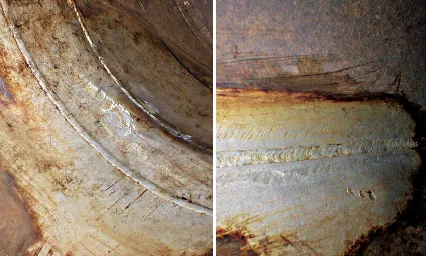
Nowy zastępca 2205 Rurę ze stali nierdzewnej dwustronnie zintegrowaną zainstalowano w 2002 roku. Długość rury wynosi 60 metrów, średnica wynosi 76,2 cm i 91,4 cm, a grubość ścianki rury wynosi 0,95 cm. System ten został opracowany zgodnie z normą ASME B31.1 Power Piping, która jest jednym z kodeksów zarządzania bezpiecznym użytkowaniem systemów rurociągów elektrowni i jest powszechnie stosowana na całym świecie. Po 500 dniach użytkowania system został dokładnie zbadany. Podczas badania nie stwierdzono żadnych osadzów ani korozji. Rura ze stali nierdzewnej 2205 wykazała się bardzo dobrą wydajnością. Rury ze stali nierdzewnej 2205 funkcjonują już od ponad dekady od momentu ich zainstalowania. Na podstawie tego doświadczenia firma Duke Power stosuje Rury ze stali nierdzewnej typu duplex 2205 w innych częściach swojego systemu.

Wnętrze rury 2205 po 500 dniach użytkowania.


Projektanci systemów wodnych w elektrowniach jądrowych mają teraz jeszcze jedną opcję przy wyborze materiałów rur do chłodzącej wody odpornej na korozję. Pomyślne zastosowanie stali nierdzewnej dwutlenkowej 2205 może obniżyć koszty konserwacji, skracać czas przestoju i zapewniać bezpieczeństwo eksploatacji elektrowni jądrowych.

The heat treatments of U stainless steel heat exchanger

When talking about the heat treatment of austenitic U-shaped stainless steel tubes, most people think it’s not necessary because of sensitization and high solution treatment temperature, it is easy to cause deformation of the pipe. In fact, the heat treatment of Austenitic stainless steel is inevitable, heat treatment can not change the structure of stainless steel tubes, but can change the processability.

For example, due to low carbon content, 304 stainless steel heat exchange tube is difficult when normalizing to make the surface roughness of the gear shaping cutter to meet the requirements, reduce the tool life. The low carbon martensite and iron cable structure obtained after incomplete quenching can greatly improve the hardness and surface roughness, and the service life of the pipe can also be increased by 3 ~ 4 times. In addition, the u-shaped heat exchange tube bending part has a small bending radius and obvious work hardening phenomenon, heat treatment is necessary, and compared with the whole equipment for heat treatment, austenitic stainless steel pipe solution heat treatment, pickling passivation is much simpler. In this paper, a series of tests have been taken on U-shaped tubes with different specifications, bending radius and heat treatment conditions, and the necessity of heat treatment for U-shaped tubes made of austenitic stainless steel has been analyzed.


Experimental materials:

304 stainless steel U-tube

Size: 19*2mm, bending radius: 40, 15, 190, 265, 340mm

Size: 25*2.5mm Bending radius: 40, 115, 190, 265, 340,mm

Heat treatment: untreated, subsolid solution treatment, solid solution treatment


Hardness Testing

The bending section of u-shaped heat exchange tube without heat treatment and subsolid solution treatment: with the decrease of bending radius, the hardness value increases. The hardness value of heat exchange tube after solution treatment (compared with that before bending) has no obvious change. This indicates that Austenitic stainless steel work hardening effect is obvious, and with the increase of deformation, the trend of work hardening increases.


Microscopic inspection

For the u-shaped bend section with a bending radius of 40mm: there are a lot of martensite and slip lines in the microstructure without heat treatment, and the equiaxed shape of austenite in the microstructure has completely disappeared (too much martensite will make the steel brittle). Most of the martensite in the subsolid solution treated tissue has been transformed, but a small amount of martensite still exists.

After solution treatment, the austenite grains were equiaxed and no martensite was found. The slip bands and martensite also existed in the unheated microstructure of u-shaped tubes with bending radius R of 115, 190, 265 and 340mm after bending, but the content decreased gradually with the increase of bending radius. When the bending radius R of the U-shaped tube is greater than or equal to 265mm, the effect on the microstructure before and after heat treatment is not significant. When the bending radius R is less than 265mm, there is martensite in the microstructure of unheated U-shaped tubes, and the content of martensite decreases with the increase of heat treatment temperature (subsolid solution treatment and solid solution treatment).


Intergranular corrosion test

By microscopic examination, it was found that the presence of martensite did not affect intergranular corrosion. Although there is a large amount of martensite in the absolutized microstructure, there is no tendency of intergranular corrosion along with the distribution of martensite. Some grain boundaries widened before and after solution treatment, and the distribution of grain boundaries widened was independent of the distribution of martensite. On the basis of microscopic examination after the corrosion test, the bending test was carried out for u-shaped tubes in various states according to the test standard. No intergranular corrosion cracks were found in the tubes after bending 180°.


Solution treatment temperature

The effect of solution treatment is affected by the low solution temperature, and the results of microstructure and hardness can not be obtained. If the temperature is slightly higher, defects such as concave or crack may appear inside the U-shaped segment.


From the experiment, it is known that the martensite transformation of stainless steel after cold processing, the influence of corrosion resistance is far greater than the stress. When the bending radius of the u-shaped tube is less than 115mm, the microstructure of the u-shaped tube before and after solution treatment is significantly different. For this small radius U-shaped pipe bend segment, solid solution treatment should be performed after cold forming. If there is no requirement for higher intergranular corrosion resistance, it is recommended that the u-shaped bending section with a bending radius less than or equal to 265mm be treated with solution treatment (note to eliminate residual stress). For u-shaped heat exchange tubes with large radius curvature, the bending section may not be treated with solution, except for stress corrosion sensitive environments. Because the small pipe diameter fluid resistance is large, it is inconvenient to clean and easy to block the structure, and the large diameter stainless steel pipe fluid resistance is not as large as the small pipe diameter, easy to clean, more used for viscous or dirty fluid.


WLD Company can provide 304/316 stainless steel heat exchange tubes from 10mm to 114mm, the thickness of 0.6mm to 3.0mm; The length can be customized according to your actual working conditions. If you need it please contact us today.

The polishing treatment on stainless steel tube

The polishing treatment of stainless steel tubes is actually a surface grinding process, through the instrument and stainless steel tube surface friction to obtain a bright surface. Stainless steel tube outside polishing is used to cut the surface with different coarse particle size linen wheel to obtain the bright surface, and the internal polishing is in the stainless steel tube inside the reciprocating or selective movement of the internal grinding with plastic grinding head. It is worth noting that polishing can not improve the original machining accuracy but only change the surface flatness, the surface roughness value of polished stainless steel tube can reach 1.6-0.008um. According to the processing process, can be divided into mechanical abandonment and chemical polishing.


Polerowanie mechaniczne

Wheel polishing: The use of the flexible polishing wheel and fine abrasive on the surface of the steel pipe roll and micro-cutting to achieve the polishing process. The polishing wheel is made of overlapping layers of canvas, felt or leather, used for polishing large workpieces.

Roller polishing and vibration polishing is to put the workpiece, abrasive and polishing fluid into the drum or vibration box, the drum slowly rolling or vibration box vibration makes the workpiece and abrasive friction, polishing liquid chemical reaction can remove the steel pipe surface stains, corrosion, and burr to obtain a smooth surface. It’s suitable for large workpieces. The grinding resistance is related to the grinding machinery, the rigidity of the workpiece, and also has a relationship with the grinding vibration amplitude or grinding temperature, which affects the life of the grinding tool and the character of the grinding surface. The grinding temperature will cause the thermal deformation of the workpiece, reduce the dimensional accuracy, and also affect the processing metamorphic layer of the grinding surface.

Polerowanie chemiczne

The stainless steel tube is immersed in a special chemical solution. The phenomenon that the raised part of the metal surface dissolves faster than the concave part is used to achieve the process of polishing.

Chemical polishing is less investment, fast speed, high efficiency, good corrosion resistance; However, there are also brightness differences, gas overflow needs ventilation equipment, heating difficulties, suitable for complex parts and small parts of the light intensity requirements are not high products.

Polerowanie elektrolityczne

Electrolytic anode polishing on stainless steel tube is the process insoluble metal as the cathode, the poles into the electrochemical trough at the same time, through direct current (dc) and selective anodic dissolution, so stainless steel tube surface to achieve high brightness and luster appearance, and form – a sticky film on the surface, enhance the corrosion resistance of the pipe, applicable to occasions with higher requirements for surface quality.

Mirror polishing

Stainless steel mirror processing is actually a kind of polishing process, to the stainless steel pipe through the grinder counterclockwise rotation, correction wheel drive workpiece rotation, pressure on the pipe in the way of gravity pressure, In the matching grinding emulsion (mainly metal oxide, inorganic acid, organic lubricant and weak alkaline cleaning agent melt), stainless steel decorative tube and grinding disk for relative operation friction to achieve the purpose of grinding and polishing. The grade of polishing is divided into ordinary polishing, 6K, 8K, 10K, of which 8K grinding has been widely used because of the low process cost.

The weight chart of stainless steel square and rectangle tube

The stainless steel offers good corrosion resistance against most common chemical corrodents and industrial atmospheres. The stainless square or rectangle tubes have the advantages of long service life, good corrosion resistance and lightweight can be used in industrial piping, automotive, instrumentation, medical and construction industries, such as stair handrails, railings, partitions, bicycles, medical equipment, cars and so on. Here is the weight chart of 304 square and rectangle tubing:

304 Stainless steel square and rectangle tubing weight 

Length:6000mm, Unit:KG

Size 0.4 0.5 0.6 0.7 0.8 0.9 1 1.2 1.5 2 2.5 3 4 5
10×10 0.74 0.91 1.09 1.26 1.43 1.59
12×12 0.89 1.1 1.32 1.53 1.73 1.93 2.13 2.53
15×15 1.12 1.39 1.66 1.92 2.19 2.45 2.71 3.21 3.95
18×18 1.35 1.68 2 2.32 2.64 2.96 3.28 3.9 4.8
19×19 1.42 1.77 2.12 2.46 2.8 3.13 3.47 4.12 5.09 6.63
20×20 1.5 1.87 2.23 2.59 2.95 3.3 3.66 4.35 5.37 7.01
22×22 2.06 2.46 2.86 3.25 3.65 4.04 4.81 5.94 7.78
23×11 1.58 1.89 2.19 2.49 2.79 3.09 3.67 4.52 5.87
23×23 2.15 2.57 2.99 3.14 3.82 4.23 5.04 6.23 8.16
24×12 1.77 2.12 2.46 2.8 3.13 3.47 4.12 5.09 6.63
24×24 2.25 2.69 3.12 3.56 3.99 4.42 5.27 6.51 8.54
25×25 2.34 2.8 3.26 3.71 4.16 4.61 5.49 6.8 8.92
28×28 2.63 3.14 3.66 4.17 4.67 5.18 6.18 7.66 10.06
30×30 2.82 3.37 3.92 4.47 5.02 5.56 6.64 8.23 10.82
36×23 2.77 2.31 3.86 4.4 4.93 5.46 6.52 8.08 10.63
36×36 3.39 4.06 4.72 5.38 6.04 6.7 8.01 9.94 13.1
38×38 4.99 5.69 6.39 7.08 8.46 10.51 13.86
40×40 5.26 5.99 6.73 7.46 8.92 11.08 14.63
48×23 4 4.66 5.31 5.96 6.61 7.89 9.8 12.91
48×48 6.32 7.21 8.1 8.98 10.75 13.37 17.67
50×50 6.59 7.52 8.44 9.37 11.2 13.94 18.43 22.85
20×10 1.12 1.39 1.66 1.92 2.19 2.45 2.71 3.21
25×13 1.42 1.77 2.12 2.46 2.8 3.13 3.47 4.12 5.09 6.63
30×15 2.1 2.52 2.92 3.33 3.73 4.13 4.92 6.09 7.97
38×25 3.54 4.12 4.7 5.27 5.84 6.98 8.66 11.39
40×10 2.8 3.26 3.71 4.16 4.61 5.49 6.8 8.92
40×20 3.37 3.92 4.47 5.02 5.56 6.64 8.23 10.82
50×25 4.23 4.92 5.61 6.3 6.99 8.35 10.37 13.67
60×30 5.92 6.76 7.59 8.41 10.06 12.51 16.53 20.47
75×45 7.92 9.04 10.16 11.27 13.49 16.79 22.24
55×13 3.83 4.46 5.08 5.7 6.32 7.55 9.37 12.34
60×40 6.59 7.52 8.44 9.37 11.2 13.94 18.43 22.85
60×60 7.92 9.04 10.16 11.27 13.49 16.79 22.24 27.61 32.91
70×30 6.59 7.52 8.44 9.37 11.2 13.94 18.43 22.85
73×43 7.65 8.73 9.81 10.89 13.03 16.22 21.48 26.66
80×40 10.16 11.27 13.49 16.79 22.24 27.61 32.91
80×60 11.87 13.17 15.77 19.64 26.04 32.37 38.62 50.89
80×80 13.58 15.07 18.05 22.5 29.85 37.13 44.33 58.5
95×45 11.87 13.17 15.77 19.64 26.04 32.37 38.62 50.89
100×40 13.17 15.77 19.64 26.04 32.37 38.62 50.89
100×50 14.12 16.91 21.07 27.95 34.75 41.47 54.7
120×60 20.34 25.35 33.66 41.88 50.04 66.12 81.9
150×100 35.34 46.98 58.53 70.02 92.76 115.2
100×100 22.62 28.21 37.46 46.64 55.74 73.73 91.41
150×150 42.48 56.52 70.43 84.29 111.79 138.99

Is Alloy20 a nickel-based alloy or stainless steel?

Alloy20 (N08020) is an Austenitic nickel-iron-chromium-based superalloy with excellent resistance to total, intergranular, pitting and crevice corrosion in chemicals containing chlorides, sulfuric acid, phosphoric acid and nitric acid. Its corrosion resistance is good between 316L and Hastelloy, and it is not as good as 316L stainless steel in some amine solutions because it is easy to form nickel ammonium complexes.

In addition, it has a good cold forming and weldability even at up to 500℃. The low carbon content and the addition of niobium help to reduce the precipitation of carbides in the HEAT affected zone, so it can be used in the welded state in most cases.

For a long time, many people have been arguing: Is Alloy 20 a stainless steel or a nickel Alloy? Because their 32-38% nickel content is just close to 36%, the boundary between stainless steel and nickel-based alloys blurs the classification of materials. In general, it is true that alloy20 is a nickel alloy. The new edition of ASTM A240 includes alloy 20, which supports that alloys 20 have been classified as stainless steel from the side. Alloy20 plates are in accordance with ASTM B463, ASME SB463. The same materials as N08904 (904L), N08926(1.4529), etc., were early classified in the ASTM B nickel alloy standard series.


Alloy20 has the common characteristics of nickel alloy in terms of welding properties, that is, generally does not produce cold cracks when welding, and is more prone to produce hot cracks. Because of nickel and sulfur, phosphorus can form low melting eutectic, solidification often forms a thick dendritic austenite crystal, low melting point impurity is more likely to focus on grain boundary, the grain size and the effect of solidification shrinkage stress and welding stress, not entirely solidification grain boundary of low melting point material is easy to cracking formation of hot crack, so should strictly control the sulfur and phosphorus content of welding material.

Alloy 20 has excellent resistance to stress corrosion cracking, good resistance to local corrosion, satisfactory corrosion resistance in many chemical process media, chlorine gas and all kinds of media containing chloride, dry chlorine gas, formic and acetic acid, anhydride, seawater and saltwater, etc. At the same time, 20 alloy oxidation-reducing composite media corrosion, is often used in a sulfuric acid environment and containing halogen ions and metal ions sulfuric acid solution applications, such as hydrometallurgy and sulfuric acid industrial equipment.

First developed in 1951 for application in sulfuric acid, alloy 20 is the preferred alloy for sulfuric acid industrial environments. In 20% ~ 40% boiling sulfuric acid, it shows excellent resistance to stress corrosion cracking, and is an excellent material for many industries such as the chemical industry, food industry, pharmaceutical industry and plastics. It can be used in heat exchangers, mixing tanks, metal cleaning and pickling equipment and pipelines. Alloy 20 can also be applied in synthetic rubber manufacturing equipment, pharmaceuticals, plastics, organic and heavy chemical processing, storage tanks, pipes, heat exchangers, pumps, valves and other process equipment, pickling equipment, chemical process pipes, bubble caps, food and dye production is often used.