The thickness tolerance of stainless steel plate

We usually call the thickness of 4-25.0 mm stainless steel plate in the middle plate, the thickness of 25.0-100.0mm stainless steel thick plate, thickness of more than 100.0mm is extra thick plate.When looking for a suitable stainless steel plate, there are several different grades available based on the strength of the metal and its chemical composition. There is a high grade that is made from Cr-Ni alloys which are generally used in commercial applications such as Pressure vessels, boiler shells, bridges, automobiles, shipbuilding, construction and other industrial purposes.

It is important to note what type of use the stainless steel plate is going to have in any given industrial application. Some applications require a hardened, reinforced plate that is able to withstand hammer blows, abrasions and impact. Others may require a more brittle, softer material that is able to cope with bending and deformation. The other criteria that need to be observed is the degree of corrosion resistance and this will dictate what grade of stainless steel plate is best for the application. The conmmonly used grades are 304, 316L, 310S, and 904L stainless steel plate. Here is the allowable thickness tolerance of stainless steel plate from ASTM, JIS and GB specification.


JIS Stainless steel plate

Thickness Width
<1250 ≥1250<1600
≥0.30~<0.60 士0.05 士0.06
≥0.60~<0.80 士0.07 士0.09
≥0.80~<1.00 士0.09 士0.10
≥1.00~<1.25 士0.10 士0.12
≥1.25~<1.60 士0.12 士0.15
≥1.60~<2.00 士0.15 士0.17
≥2.00~<2.50 士0.17 士0.20
≥2.50~<3.15 士0.22 士0.25
≥3.15~<4.00 士0.25 士0.30
≥4.00~<5.00 士0.35 士0.40
≥5.00~<6.00 士0.40 士0.45
≥6.00~<7.00 士0.50 士0.50


ASTM Stainless steel plate

Thickness Allowable tolerance Width
上 下 ≤1000 >1000~≤1300
0.10 0.03 0.03
0.15 0.04 0.04
0.20 0.05 0.05
0.25 0.05 0.05
0.30 0.03 ——-
0.40 0.04 0.04
0.50 0.08 0.08
0.50 0.045 0.05
0.60 0.05 0.05
0.75 0.10 0.10
0.80 0.05 0.05
1.00 0.055 0.06
1.20 0.08 0.08
1.25 0.13 0.13
1.50 0.08 0.08
1.75 0.15 0.15
2.00 0.18 0.18
2.00 0.10 0.10
2.25 0.20 0.20
2.50 0.23 0.23
2.50 0.10 0.11
2.75 0.25 0.25
3.00 0.25 0.25
3.00 0.13 0.13
3.25 0.30 0.30
3.50 0.30 0.30
3.75 0.36 0.36
4.00 0.36 0.36
4.00 0.17 0.17
4.99 0.36 0.36
5.00 0.17 0.17
6.00 0.17 0.20
8.00 0.17 0.


GB Stainless Steel Plate

Thickness Allowable thickness tolerance
High precision(A) Standard precision(B)
>600~1000 >1000~1250 >600~1250
0.05~0.10 ——- ——- ——-
>0.10~0.15 ——- ——- ——-
>0.15~0.25 ——- ——- ——-
>0.25~0.45 士0.040 士0.040 士0.040
>0.45~0.65 士0.040 士0.040 士0.050
>0.65~0.90 士0.050 士0.050 士0.060
>0.90~1.20 士0.050 士0.060 士0.080
>1.20~1.50 士0.060 士0.070 士0.110
>1.50~1.80 士0.070 士0.080 士0.120
>1.50~2.00 士0.090 士0.100 士0.130
>2.00~2.30 士0.100 士0.110 士0.140
>2.30~2.50 士0.100 士0.110 士0.140
>2.50~3.10 士0.110 士0.120 士0.160
>3.10~4.00 士0.120 士0.130 士0.180

Is 318LN a type duplex stainless steel grades?

318LN is Nitrogen-enhanced stainless steel commonly used to address corrosion failures in 300 series stainless steel. The structure of 318LN stainless steel is composed of Austenite surrounded by continuous Ferrite phases. 318LN contains about 40-50% Ferrite in the annealed state and can be considered duplex stainless steel. The duplex structure combines ferrite alloys (stress corrosion cracking resistance and high strength) with the superior qualities of Austenitic alloys (ease of manufacture and corrosion resistance). The 318LN is resistant to H2S uniform corrosion, sulfide stress cracking, hydrogen embrittability and pitting, and reducing media corrosion. It is commonly used to manufacture sulfur-resistant wellheads, valves, stems, and fasteners for use in mining environments where H2S partial pressures exceed 1MPa. However, the use of 318LN duplex stainless steel should be limited to less than 600°F because prolonged high temperatures can brittle the 318LN stainless steel.


The chemical composition of 318LN steel

Cr Ni Mo C N Mn Oui P S
22.0-23.0 4.50-6.50 3.00-3.50 ≤0.030 0.14-0.20 ≤2.00 ≤1.00 ≤0.030 ≤0.020
Mechanical Property
Ys (Mpa) Ts (Mpa) Elongation (%) Hv
Normes ≥ 450 ≥ 620 ≥ 18
Physical property
Density (g/cm) Specific heat(J/g.C) Thermal conductivity

100C(W/m.)

The coefficient of thermal expansion

20~100C (10/C)

7.8 0.45 19.0 13.7


Features of 318LNsteel

  • Excellent resistance to sulfide stress corrosion
  • Good resistance to chloride stress corrosion cracking, pitting and crevice corrosion
  • High strength,
  • Good weldability and workability


Applications of 318LNsteel

  • Chemical treatment containers, pipes and heat exchangers
  • Pulp mill digesters, bleach cleaners, chip presteam containers
  • Food processing equipment
  • Petrochemical pipelines and heat exchangers
  • Flue gas desulfurization equipment


318LN duplex stainless steel is an economical and effective solution for applications where 300 series stainless steel are susceptible to chloride stress corrosion cracking. When stainless steel is subjected to tensile stress, stress corrosion cracking will occur in contact with a solution containing chloride, and rising temperature will also increase the sensitivity of stainless steel to stress corrosion cracking. The combination of chromium, molybdenum, and nitrogen enhances the 318LN’s resistance to chloride pitting and crevice corrosion, which is critical for services such as marine environments, brackish water, bleaching operations, closed-loop water systems, and some food processing applications. In most environments, 318LN’s high chromium, molybdenum and nitrogen content provides superior corrosion resistance to ordinary stainless steels such as 316L and 317L.

High strength stainless steel used in aircraft applications

We usually call tensile strength higher than 800MPa, yield strength higher than 500MPa stainless steel is high strength stainless steel, yield strength higher than 1380MPa stainless steel is called ultra high strength stainless steel. The development of the aviation industry has proved that the improvement of aircraft and aero-engine performance largely depends on metal materials. Due to the high strength, high toughness, high stress corrosion cracking resistance and good impact resistance of steel, some key structural components of aircraft such as landing gear, girder, high stress joints, fasteners and other high strength stainless steel are still used.

High strength stainless steel mainly includes Martensite precipitation hardening stainless steel and semi – Austenite precipitation hardening stainless steel. The strength of martensite precipitation hardening stainless steel is achieved by martensite transformation and precipitation hardening treatment, the advantage is high strength, at the same time due to low carbon, high chromium, high molybdenum and/or high copper, its corrosion resistance is generally not less than 18Cr-8Ni austenitic stainless steel; Free cutting, good welding ability, do not need local annealing after welding, heat treatment process is relatively simple. The main disadvantage is that even in annealed state, its structure is still low carbon martensite, so it is difficult to conduct deep deformation cold working. The typical steel grade is 17-4PH and PH13-8Mo, used for the manufacture of high strength corrosion resistant bearing components, such as engine bearing parts, fasteners, etc. working at 400℃. PH13-8Mo is widely used in aeronautical bearing corrosion resistant medium temperature structural parts.

The semi-Austenite precipitation hardened stainless steel can be machined, coldly deformed and welded in Austenite state, and then the martensite transformation and precipitation hardening can be controlled by adjusting aging to obtain different strengths and toughness coordination. The steel has good corrosion resistance and thermal strength, especially stress corrosion resistance, and is especially suitable for the manufacture of parts used below 540℃. The disadvantage is that the heat treatment process is complex, the heat treatment temperature control requirements are very accurate (±5℃); The work hardening tendency of steel is large, and many intermediate annealing times are often needed for deep deformation cold working. Typical grades are 17-7PH, PH15-7Mo, etc. This kind of steel is mainly used in the aviation industry to work at 400℃ below the corrosion bearing structure, such as all kinds of pipes, pipe joints, springs, fasteners, etc.


Aircraft landing gear

The materials used for the construction of aircraft landing gear are 30CrMnSiNi2A, 4340, 300M, Aermet100 and other aircraft landing gear and fasteners with higher requirements are mostly made of precipitation hardened stainless steel, such as 17-4PH for THE landing gear of F-15 aircraft, 15-5pH for the landing gear of B-767 aircraft. PH13-8mo steel has the potential to replace 17-4PH, 15-5PH, 17-7PH, PH15-7Mo and other steels due to its better stress corrosion resistance than precipitation hardened stainless steel of the same grade.

The plane bearing

German FAG company developed the nitrogen-added martensite stainless steel Cronidur30 (0.31%C-0.38%N-15% Cr-L %Mo), which is produced by PESR process of electroslag remelting under high pressure nitrogen atmosphere. It is a high temperature stainless steel with high nitrogen completely hardened, which is more resistant to corrosion than SUS440. It is not suitable for high DN value (D: bearing inner diameter/mm, N: shaft revolution/arin) because of its characteristics of full hardening type, the same Cronidur30 can satisfy the residual compressive stress and fracture toughness value of DN4 million at the same time through high-frequency quenching. But the tempering temperature is lower than 15O℃, it can not withstand the rise in bearing temperature caused by thermal shock after engine shutdown.

Aircraft bearing structural components

High-strength stainless steel in aircraft bearing structure is mainly 15-5PH, 17-4PH, PH13-8Mo, etc., including hatch cover latch, high-strength bolt, spring and other parts. Civil aircraft use such high-strength stainless steel for wing spars, such as 15-5PH steel for Boeing 737-600 wing spars; Type A340-300 wing SPAR PH13-8Mo steel. Ph13-8Mo is used for parts requiring high strength and toughness, especially for transverse performance, such as fuselage frames. More recently, Custom465 has been tested due to increased toughness and stress corrosion resistance. Custom465 was developed by Carpenter on the basis of Custom450 and Custom455 for the manufacture of aircraft flap guides, slat guides, transmissions, engine mounts, etc. The steel is currently included in the MMPDS-02, AMS5936 and ASTM A564 technical specifications. HSL180 high strength stainless steel (0.21C-12.5Cr-1.0Ni-15.5Co-2.0Mo) is used to manufacture the aircraft structure, which has the same strength of 1800MPa as low alloy steel such as 4340 and the same corrosion resistance and toughness as precipitation hardened stainless steel such as SUS630.


Avantages des raccords à coude en acier inoxydable

Stainless steel pipe fittings, especially tee, elbow and the reducer is more and more common in pipeline engineering use because of their good shaping, corrosion resistance, high temperature and high-pressure resistance, welding, and other characteristics. Compared with the carbon steel pipe fittings, stainless steel pipe fittings has been often used in drinking water transportation, petrochemical and other pipelines with high requirements for the environment. To make things easy for those who don’t know much about them, this article is meant to enlighten you about this product line and its various features. What’s more, we would also discuss the benefits that you can expect from using them. By the time you’ve finished reading through this article, you would definitely have a good idea about what these products are and how you can get your hands on them.

304 stainless steel elbow specifications

DN NPS Series A Series B 45°Elbow 90°Elbow 180°Elbow
DN NPS Series A Series B L.R L.R S.R L.R S.R L.R S.R
15 1/2 21.3 18 16 38 – 76 – 48 –
20 3/4 26.9 25 19 38 – 76 – 51 –
25 1 33.7 32 22 38 25 76 51 56 41
32 1.1/4 42.4 38 25 48 32 95 64 70 52
40 1.1/2 48.3 45 29 57 38 114 76 83 62
50 2 60.3 57 35 76 51 152 102 106 81
65 2.1/2 76.1(73) 76 44 95 64 190 127 132 100
80 3 88.9 89 51 114 76 229 152 159 121
90 3.1/2 101.6 – 57 133 89 267 178 184 140

These commonly used grades in the pipe connection are 304, 316, and 316l stainless steel elbow. They are often widely used in the manufacturing and automotive, pharmaceutical and food industries. In fact, it’s not uncommon to find these products being used in food processing plants. The reason behind their wide usage is quite straightforward – they provide effective support to the working parts of the machinery, without hampering the other quality of work. As mentioned above, they use a specially designed welding process called bending heat cure to ensure that the elbow joint is supported by high-strength stainless steel pipe fittings. This in turn ensures that the pipe fittings can be replaced whenever needed.

Another major advantage of using stainless steel fitting is its corrosion resistance;. Since stainless steel is alloy steel with the Cr and Mo added, it has the potential to become an integral part of many industrial processes, where conductivity is crucial. This means that an electrical fault can affect the functioning of a facility, and it may not just be a matter of switching off the supply. For instance, when a power failure occurs in a chemical manufacturing plant, emergency personnel have to access the area on their own, which could prove very difficult for them to do if the power distribution points are not properly located.


WLD steel is a 304 stainless steel 90-degree elbow supplier and manufacturer. To begin with, they are manufactured to ensure top-quality performance. This means that they are fitted with stainless steel pipe fittings of the right diameter and length for the job, irrespective of the pipe size or shape. For instance, there may be a need to fit pipes of different widths, varying from two-inch increments to four-inch increments. A well-designed product will be able to accommodate these demands without any hassle.


La prévention de la corrosion des pipelines en surface

La corrosion de Les pipelines souterrains Il est causé par l’action combinée d’ions corrosifs (Cl-, S2-), de CO2, de bactéries et d’oxygène dissous. L’oxygène dissous est un puissant oxydant ; il est facile d’oxyder les ions ferreux pour former des précipitations ; la relation entre l’oxygène dissous et le taux de corrosion est linéaire. Les bactéries réduisant l’oxygène dissous retrouveront l’oxygène dissous dans l’eau, ce qui peut provoquer des fissures induites par l’hydrogène dans les tuyaux et des fissures de corrosion due à la contrainte ; les produits de corrosion générés par le fer dissous sont difficiles à éliminer et se déposent sur la surface de l’acier ; ils sont peu résistants à l’oxydation et tombent facilement ; ils sont potentiellement dangereux car ils constituent une microbatterie active et une matrice d’acier, et continuent à produire de la corrosion sur le substrat métallique. Les bactéries saprophytes adhèrent au pipeline et provoquent une obstruction, ainsi que la formation de cellules d’oxygène concentré ; cela peut également provoquer une corrosion de la matrice métallique et des fissures dans le pipeline. Le mélange huile-eau dans le pipeline peut pénétrer dans le réservoir d’eaux usées après la séparation. Par conséquent, lors du choix des mesures anti-corrosion pour les pipelines souterrains dans les gisements pétrolifères, il convient de prendre en considération l’effet de protection, la difficulté de construction, le coût et d’autres facteurs. Certaines mesures anti-corrosion couramment utilisées pour les pipelines souterrains dans les gisements pétrolifères sont les suivantes :


Couverture

De nombreux revêtements anticorrosion sont appliqués sur les pipelines, et leur performance varie. Choisir les revêtements appropriés peut considérablement prolonger la durée de vie des pipelines. En fonction de l’environnement corrosif, des milieux de transport et d’autres conditions, il convient de choisir les revêtements appropriés. Le revêtement extérieur est la première et la plus importante barrière de la tuyauterie souterraine en acier, composé principalement de revêtements organiques et métalliques (ou de revêtements). Les revêtements organiques peuvent être divisés en résine époxy, époxy phénolique modifié, asphalte, goudron de houille et autres revêtements. Les résultats expérimentaux montrent que la surface du revêtement ne présente pas de bulles lors de l’immersion dans l’eau de mer et l’huile, et que le revêtement satisfait aux exigences de l’API RP 5L2 en matière d’adhérence et de test de décollement, ce qui indique que le revêtement présente une bonne adhérence. Le revêtement est chauffé à 250 °C pendant 30 minutes puis refroidi à température ambiante par de l’eau. La surface du revêtement ne présente pas de décollement, de fissuration, de bulles, de perte d’adhérence, etc., c’est-à-dire que le revêtement présente une bonne résistance à la chaleur. Selon les normes ASTM D522, ASTM D968 et d'autres normes visant à effectuer des essais de flexion et d'usure, la couche de revêtement présente également une bonne résistance à la flexion et à l'usure.


Protection cathodique

Il n’est pas facile de revêtir la surface intérieure des pipelines de petit diamètre (diamètre des tubes inférieur à 60 mm). Même si la couche de revêtement est réalisée à l’intérieur, il est difficile d’obtenir une surface libre de trous de 100% piques. De plus, la couche de paroi intérieure est souvent exposée à l’usure lors de l’utilisation, de sorte que l’utilisation de la protection cathodique peut efficacement réduire les perforations dues à la corrosion. La protection cathodique sacrificielle est la méthode de protection cathodique la plus ancienne, facile à utiliser et ne nécessitant pas d’alimentation électrique. Les matériaux d’anode sacrificielle utilisés couramment en Chine comprennent le magnésium, le zinc, l’aluminium et leurs alliages.

La tension de sortie de l’anode sacrificielle dépend de sa forme et de sa taille. Lors des essais en laboratoire sur le magnésium, le zinc et l’alliage d’aluminium ayant un potentiel cathodique (par rapport à l’électrode de référence en cuivre/sulfate de cuivre), trois types d’alliages sont conformes aux exigences de la spécification de la protection cathodique des stations pétrolières et gazées (le potentiel cathodique de protection est de 0,85 V ou plus). L’alliage d’anode en aluminium présente le meilleur effet de protection, tandis que l’alliage d’anode en magnésium et l’alliage d’anode en zinc sont moins performants.


Joint spécial

Cette jointure spéciale est conçue pour remédier aux dommages causés par la soudure des tuyaux après la mise en œuvre de la couche de revêtement. Les méthodes comprennent : l’utilisation d’un matériau isolant réfractaire et d’un revêtement à haute température ; ou l’utilisation d’une nouvelle forme de joint en céramique à haute température à isolation thermique, qui présente d’excellentes performances d’isolation thermique et de résistance à la corrosion, ainsi qu’une bonne résistance à la chaleur et une bonne résistance à la corrosion dans les variations brusques de température ; toutefois, son inconvénient est que sa résistance à la rupture et sa résistance à la pénétration sont faibles. Les essais de laboratoire montrent que, dans les conditions de variations brusques de température, la résistance à la rupture et la résistance à la pénétration de la jointure peuvent satisfaire aux exigences ; toutefois, dans le cadre de la garantie de la résistance et de la ténacité, l’épaisseur de la paroi de la jointure est trop importante et le changement de diamètre intérieur affecte la réalisation normale de la structure. pipelineL’utilisation de matériaux isolants réfractaires et de joints de revêtement à haute température peut répondre pleinement aux exigences d’utilisation.


Why is duplex stainless steel used in nuclear power plant cooling water systems?

As a clean energy source, nuclear power is a major contributor to reducing carbon emissions worldwide. The cooling water piping system is the key to the safe operation of a nuclear power plant. It consists of thousands of feet of pipes of various diameters and sizes. It provides a reliable water supply for the cooling of plant equipment. The non-safety piping system must provide enough cooling water to cool the plant, while the safety system must provide enough cooling water to bring the reactor under control and safely shut it down in case of an emergency.

These pipe materials must be resistant to cooling water corrosion throughout the service life of the equipment. Depending on the plant’s location, the type of cooling water can range from relatively clean fresh water to contaminated seawater. Experience has shown that as systems age, a variety of corrosion problems and varying degrees of corrosion can occur, damaging the system and preventing it from providing the required cooling water.

Problems with cooling water piping often involve materials and their interactions with cooling water. Leakage from fouling (plugging) and corrosion of the system are the most common problems, including sediment accumulation, Marine biological attachment (biofouling), accumulation of corrosion products, and blockage of foreign matter. Leakage is usually caused by microbial corrosion (MIC), which is very corrosive corrosion caused by certain microorganisms in water. This form of corrosion occurs frequently in carbon steel and low-alloyed stainless steel.

Stainless steel has long been considered a viable option for building new water supply piping systems and for repairing or replacing existing carbon steel systems. The stainless steel commonly used in piping upgrade solutions is 304L, 316L, or 6%-Mo stainless steel. 316L and 6% Mo stainless steel yo big differences in performance and price. If the cooling medium is untreated water, which is highly corrosive and carries a risk of microbial corrosion, 304L and 316L are not suitable choices. As a result, nuclear plants have had to upgrade to 6%-Mo stainless steel or accept the high maintenance costs of carbon steel systems. Some nuclear power plants still use carbon steel lining pipes because of the lower initial cost. According to ASTM A240,Industrial water supply piping systems are often made of stainless steel below:

Notes UNS C N Cr Ni Mo Cu
304L S30403 0.03 / 18.0-20.0 8.0-12.0 / /
316L S31603 0.03 / 16.0-18.0 10.0-14.0 2.0-3.0 /
6%Mo N08367 0.03 0.18-0.25 20.0-22.0 23.0-25.0 6.0-7.0 0.75
2205 S32205 0.03 0.14-0.2 22.0-23.0 4.5-6.5 3.0-3.5 /

The 2205 duplex stainless steel proved to be an excellent choice. Duke Power’s Catawba nuclear power plant in South Carolina is the first nuclear power plant to use 2205 (UNS S32205) dual-phase stainless steel in its systems. This grade contains approximately 3.2% molybdenum and has improved corrosion resistance and significantly better microbial corrosion resistance than 304L and 316L stainless steels.

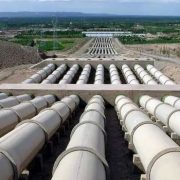
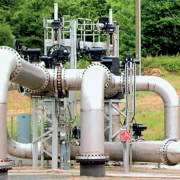
The carbon steel lining piping on the overground portion of the piping system conveying the supply water to the cooling tower of the main condenser was replaced with 2205 duplex stainless steel piping.

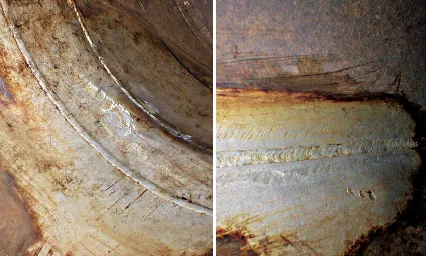
The new replacement 2205 duplex stainless steel pipe was installed in 2002. The pipe is 60 meters long, 76.2 cm and 91.4 cm in diameter, and the wall thickness of the pipe is 0.95 cm. The system specified in accordance with ASME B31.1 Power piping, which is one of the management codes for the safe use of power plant piping systems and is widely used in the world. After 500 days of service, the system was thoroughly inspected. No scaling or corrosion was found during the inspection. 2205 duplex stainless steel performed very well. 2205 stainless steel piping has been performing well for more than a decade since its installation. Based on this experience, Duke Power has used 2205 duplex stainless steel pipes in other parts of its system.

Internal of 2205 pipe after 500 days use.


Designers of nuclear power plant water systems now have one more option when it comes to choosing piping materials for corrosion-resistant cooling water. The successful application of 2205 duplex stainless steel can reduce maintenance costs, reduce downtime and ensure the operation safety of nuclear power plants.