
304 Stainless Steel VS 321 Stainless Steel

Both grade 304 and 321 belong to the Austenitic 300 series stainless steel. They are similar in corrosion resistance, strength, hardness and welding performance, but 321 is mostly used in the heat resistance condition of 500-600 ℃. 321H stainless steel is the low-carbon version of 321, is the commonly used heat resistant steel, of which carbon content is slightly higher than 321 grades. 304 steel is an alternative to 321 stainless steel where intergranular corrosion resistance rather than high temperature strength is required.

In a way, grade 321 stainless steel is a new version based on grade 304 by adding Ti to improve the corrosion resistance of grain boundary and high temperature strength. As a stabilizing element, Ti element control the formation of chromium carbide, effectively, making 321 has a robust high-temperature strength, even much better than 304, 316L. A larger content of nickel makes 321 stainless steel has good abrasion resistance in different concentrations and temperatures of organic acids, especially in oxidizing media. 321 stainless steel has better Stress Rupture property and Creep Resistance Stress mechanical property than 304 stainless steel. Let me show exactly is the difference between them with the two tables below.


Chemical Composition of 304, 321, 321H

Nilai C Si Mn Cr Ni S P N Ti
304 0.08 1.0 2.0 18.0~20.0 8.0~10.5 0.03 0.045 / /
321 0.08 1.0 2.0 17.0-19.0 9.0-12.0 0.03 0.045 0.1 5C-0.70
321H 0.04-0.1 1.0 2.0 17.0-19.0 9.0-12.0 0.03 0.045 0.1 0.16-0.7


Mechanical Property of 304 and 321

Nilai Kekuatan tegangan, Mpa Yield strength, Mpa Elongation, % Hardness,HB
304 ≥520 205-210 ≥40≥40 HB187
321 ≥520 ≥205   HB187


As can be seen from the above table, 321 stainless steel contains titanium and more nickel (Ni) than 304, according to ASTM A182, the content of Ti should not be less than 5 times of carbon (C) content, but not more than 0.7%. Ti can prevent stainless steel sensitization and improve the high temperature service life, that is to say, grade 321 is more suitable for manufacturing wear-resistant acid containers, wear-resistant equipment and conveying pipes or other parts than 304 stainless steel in high-temperature environment.

304 and 321 stainless steel are both can be used for chemical, oil and gas, automotive fields. Grade 304  is general-purpose stainless steel and has the most extensive applications in the stainless steel family, such as tableware, cabinets, boilers, auto parts, medical appliances, building materials, chemicals, food industry, agriculture, shipping, oil transportation and so on. Grade 321 is used in chemical, coal and petroleum fields where required resistance to grain boundary corrosion and high temperature properties such as oil exhaust combustion pipes, engine exhaust pipes, boiler enclosures, heat exchangers, furnace components, diesel engine silencer components, boiler pressure vessels, chemical transport tanks, expansion joints, furnace pipes, etc
Mengapa pipa stainless steel memerlukan pengelasan penyelesaian?

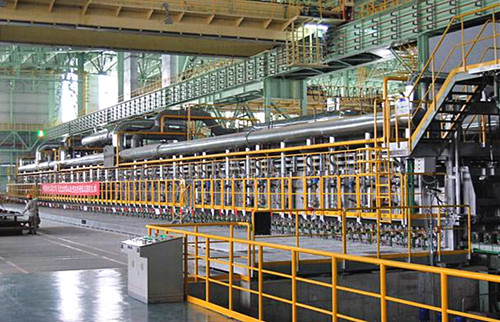
Solusi annealing juga disebut sebagai annealing solusi karbida, merupakan proses pemanasan bagian kerja hingga 1010 ℃ atau lebih tinggi untuk menghilangkan pengendapan karbida (karbon dari solusi padat stainless steel), dan kemudian dilakukan pendinginan cepat, biasanya dengan cara penyemburan air dan karbida tersebut kembali ke solusi padat stainless steel. Pengobatan annealing solusi dapat diterapkan pada baja paduan dan baja stainless. Untuk Tembaga stainless steel 304 Pengolahan dengan cara pencetakan dan pengobatan solusi dapat menghasilkan mikrostruktur yang seragam tanpa adanya kotoran karbida. Secara umum, tabung baja stainless steel dipanaskan selama jangka waktu yang lama hingga mencapai suhu sekitar 950 ~ 1150°C agar karbida dan berbagai elemen paduan larut sepenuhnya dan merata dalam austenit, lalu segera didinginkan dengan air untuk memperoleh struktur austenit yang murni karena adanya karbon dan elemen paduan lainnya yang mengalami pengendapan terlambat. Pertanyaannya adalah, mengapa tabung baja stainless steel memerlukan pengelasan dengan solusi? Pertama-tama Anda harus mengetahui fungsi dari proses pengelasan dengan solusi.

Struktur metalografis yang seragam

Ini sangat penting bagi bahan baku. Ketidakkonsistenan dalam suhu rolling dan laju pendinginan tabung baja dilas panas menyebabkan konsekuensi yang sama pada struktur. Ketika aktivitas atom meningkat pada suhu tinggi, σ terurai dan komposisi kimianya cenderung seragam, sehingga struktur satu fase yang seragam diperoleh setelah pendinginan yang cepat.


Pengecualian dari pengerasan kerja

Pengobatan dengan solusi padat mengembalikan kisi-kisi yang tertekuk dan mengkristal kembali butiran yang rusak. Tekanan internal dan kekuatan tarik dari tabung baja berkurang sementara tingkat elongasi meningkat untuk memfasilitasi kerja dingin secara terus menerus.


Tingkat ketahanan korosi yang meningkat

Ketahanan korosi baja stainless berkurang seiring dengan pembentukan karbid, dan ketahanan korosi tabung baja kembali ke kondisi terbaik setelah proses pengolahan dengan larutan padat. Suhu, waktu penahanan, dan tingkat pendinginan adalah faktor-faktor yang paling penting dalam proses pengolahan dengan larutan untuk baja stainless.

Suhu larutan padat tergantung pada komposisi kimianya. Secara umum, suhu larutan padat harus ditingkatkan secara proporsional untuk kelas dengan lebih banyak unsur paduan dan kandungan yang tinggi, terutama untuk baja dengan kandungan mangan, molibdenum, nikel, dan silikon yang tinggi. Hanya dengan meningkatkan suhu larutan padat dan membuatnya larut sepenuhnya, efek pelunakan dapat dicapai.

Namun, ada beberapa pengecualian, seperti 316Ti. Ketika suhu solusi padat tinggi, karbid dari unsur-unsur yang stabil sepenuhnya terlarut dalam Austenite, yang akan terendapkan di batas butir dalam bentuk Cr23C6 dan menyebabkan korosi antargranular pada pendinginan selanjutnya. Suhu solusi padat yang lebih rendah direkomendasikan untuk mencegah karbid (TiC dan NbC) dari unsur-unsur stabilisasi terdekomposisi dan terlarut dalam solusi padat.


Mengapa baja stainless berkarat?

As we all know, stainless steel has the ability to resist atmospheric oxidation, that is, will not rust, but also corrode in the medium like acid, alkali and salt, that is, corrosion resistance. However, the corrosion resistance of stainless steel is conditional, that is, stainless steel in a certain medium is corrosion-resistant, but in another medium may be destroyed. Correspondingly, no one of stainless steel is resistant to corrosion in all environments.

Stainless steel can provide excellent corrosion resistance in various industries, strictly speaking, they show excellent corrosion resistance in most media, but it is exceptional in some media due to low chemical stability and corrosion but. Therefore, stainless steel can not be corrosion-resistant to all media except mechanical failure. The corrosion of stainless steel is mainly manifested as a serious form of corrosion of stainless steel is local corrosion (i.e., stress corrosion cracking, pitting, intergranular corrosion, corrosion fatigue and crevice corrosion). This local corrosion causes almost half of the failure. To understand why stainless steel corrodes, we must first understand the type of corrosion of stainless steel.


Stress Corrosion Cracking (SCC)

Stress corrosion cracking (SCC) is the failure of stainless steel subjected to stress in a corrosive environment due to the expansion of strong grain. SCC has a brittle fracture morphology and can occur in materials with high toughness in the presence of tensile stress (whether residual stress or applied stress or both) and corrosive media. In the micro term, crack through the grain called transgranular crack, and the cracks along the grain boundary expansion graph called the intergranular crack, when the SCC extended to one depth (load stress on the section of materials to achieve its fracture stress) in the air, stainless steel as normal crack (in ductile material, usually through microscopic defect aggregation) and disconnect.

Therefore, the section of a part that has failed due to stress corrosion cracking will contain areas characterized by stress corrosion cracking and “dimples” areas associated with the polymerization that has been slightly defective.


Pitting Corrosion

Pitting corrosion refers to the most non-corrosion or scattered slight local corrosion on the surface of metal materials. The size of the common pitting point is less than 1.00mm, and the depth is often greater than the surface aperture, which may be a shallow pitting pit or perforation.


Intergranular Corrosion

Intergranular corrosion: A disordered dislocation of grains at the boundary between different grains and, therefore, a favorable zone for segregation of solute elements or precipitation of metallic compounds such as carbides and δ phases in steels. Therefore, in some corrosive media, it is common that the grain boundaries may be corroded first, and most metals and alloys may exhibit intergranular corrosion in certain corrosive media.


Crevice Corrosion

Crevice corrosion refers to the occurrence of speckled corrosion in the cracks of stainless steel parts, which is a kind of local corrosion. It may occur in the cracks of solution stagnation or in the shielding surface. Such gaps may form at metal-to-metal or metal-to-nonmetal junctions, for example, at rivets, bolts, gaskets, valve seats, and loose surface deposits.


General Corrosion

Uniform corrosion on the surface of stainless steel. Stainless steels may exhibit general corrosion in strong acids and bases. When general corrosion occurs, the stainless steels gradually thin and even fail, which is not much of a concern because such corrosion can usually be predicted by a simple immersion test. It can be said that stainless steel refers to the corrosion resistance of steel in the atmosphere and weak corrosion medium, corrosion rate is less than 0.01mm/ year, that is “completely corrosion resistance”; Stainless steels with corrosion rates less than 0.1mm/ year are considered “corrosion-resistant”.